Showing posts with label Wildlife Conflict. Show all posts

Monday, 20 May 2013

Panther dies after hit by vehicle in Sariska

Rajendra Sharma, TNN May 20, 2013
ALWAR: A two-year-old male panther died in Sariska reserve after being hit by a speeding vehicle on Sunday morning. The incident took place between Kushalgarh and Bharthari areas.

The animal suffered traumatic shock, cervical fracture and a head injury, says the autopsy report.

Though the state government had come up with a panther conservation committee recently, it still remains on paper, said sources.

Panthers are endangered animals listed under Schedule 1 of Wildlife Protection Act which gives them absolute protection. A separate area was to be developed for them so that they could roam safely. According to the census conducted in 2010, the number of panthers in the reserve was put at 45 but on an average one panther is killed in road accident, poached or attacked after straying into human habitats every two days, says a study.

Concerned over the rise in panther deaths, the state was to constitute a committee for panther conservation and develop a separate territory for them in Sariska Tiger Reserve. Wildlife experts and officials of forest department were to chalk out a plan for their safety in the reserve, but hardly anything has been done so far.

According to honorary wildlife warden Anil Jain, "It is difficult for Sariska to stabilize given the fact that the Ranthambore lobby plays a very predominant role in Rajasthan. They want tourists to be diverted from Sariska and the forest department just does what they want. It has been on record that the every three to six months a divisional forest officer has been transferred from Sariska and similar is the case with the assistant conservator of forests."

Besides since the reserve is big, there is a dire need of more rangers and forest guards. "At the moment there are only six rangers which ideally should be double the number. The number of forest guards is just 110 while it should ideally be nearly 300," said Jain.

Source: http://articles.timesofindia.indiatimes.com/2013-05-20/jaipur/39392193_1_sariska-tiger-reserve-forest-guards-panther

Saturday, 11 May 2013

Tiger reserves to get full-time wildlife vets

Vijay Pinjarkar, TNN May 11, 2013
NAGPUR: In a bid to tackle man-animal conflict and give conservation a boost, the state government has decided to hire independent wildlife veterinarians in all four tiger reserves in the state.

After recent deliberations over raging man-animal conflict in Chandrapur, principal secretary (forests) Praveen Pardeshi, chief wildlife warden SWH Naqvi and field directors of tiger reserves decided to appoint wildlife vets. Directions to recruit trained vets on contract basis in Tadoba, Melghat and Pench in Vidarbha have been issued on May 7.

Pardeshi has asked field directors to recruit vets from funds under tiger conservation foundations (TCFs) on a honorarium of Rs 30,000. They have been asked to get in touch with deans of veterinary colleges and teachers to get suitable candidates. Help has also been sought from state animal husbandry commissioner.

Presently, the department has only one wildlife vet, Chitra Raut, posted at Nagpur. In case of emergencies, help from senior experts from Nagpur Veterinary College is taken. Although vets in Nagpur respond immediately, on many occasions doctors were not available in case of emergencies, proving fatal for wild animals.

Recently, when a tiger cub was hit by a speeding train and shifted to Nagpur, Raut had gone to Chandrapur to bring the animal back.

"We are making provision in the TCF budget to appoint wildlife vet on contract. There is also plan to redesignate posts of medical officers available with the department," said Virendra Tiwari, chief conservator of forests (CCF) and field director of Tadoba-Andhari Tiger Reserve ( TATR) in Chandrapur.

However, Sarjan Bhagat, additional principal chief conservator of forests (subordinate cadre), said there are six posts of medical officers with the forest department but only one from Yavatmal Circle could be made available as officers at other places like Gadchiroli and forest training colleges have said they need posts of medical officers for staff and villagers.

"We will send a proposal in this regard to the government," Bhagat said.

Wednesday, 8 May 2013

Road mishap kills bear near Navegaon

Vijay Pinjarkar, TNN | May 9, 2013
NAGPUR: With National Highway Authority of India (NHAI) reluctant to take wildlife protection measures while widening NH-6, a speeding vehicle knocked dead an adult sloth bear close to Shashikiran hills near Dongargaon early Wednesday morning.

"The spot where the bear was crushed falls in Sadak Arjuni range and borders Navegaon wildlife sanctuary. It is single road and a corridor patch. I suspect the animal must be moving towards Navegaon when it was hit," said S V Ramarao, deputy conservator of forests (DyCF), Gondia. Wild animals dying in road hits has become common on NH6, which has been widened from two lanes to four lanes. However, there is not a single patch where NHAI has taken mitigation measures.

On patches between Sakoli and Deori, Wildlife Institute of India ( WII), Dehradun, has suggested mitigation measures like constructing underpasses but this is not acceptable to NHAI, leading to accidents. On January 28, a honey badger (chandi aswal), a rare animal, was knocked dead at the same spot. The Supreme Court has already taken serious view of high mortality of wildlife on roads passing around protected areas (PAs) due to lack of mitigation measures. NHAI is yet to wake up.

Ramarao said the mishap occurred in the wee hours. There is a blind turn at the spot and the speeding vehicle must have hit the bear when it suddenly came out of the bushes to cross the road. The carcass was shifted the Dongargaon forest depot where a post-mortem was performed. Sawan Bahekar, honorary district wildlife warden of Gondia, demanded signboards at vulnerable spots and speed restrictions. "How many more wild animals will keep dying like this," he asked.

Initially officials felt it might be case of poaching but Ramarao said the bear died due to severe internal injuries. The head of the animal was crushed completely and it died on the spot.

Death Dance On NH6

January 7, 2011: A leopard died after being hit by a vehicle near Talegaon ghat under Wardha forest division

May 15, 2011: A full grown leopard knocked dead near Baghnadi between Deori and Rajnandgaon by an unidentified speeding vehicle

Sept 18, 2011: A sambar knocked dead in Duggipar beat under Sadak Arjuni range in Kohmara in Navegaon-Nagzira corridor

On Nov 23, 2011: A full grown leopard knocked dead in the evening near Bazargaon paper mill near Nagpur in Kalmeshwar forest range

Dec 22, 2011: An adult leopard died in road hit near Dongargaon

Jan 6, 2013: A jungle cat found dead near Hardoli, 35km from Nagpur on Amravati Road. The carnivore was hit on its head and died due to excessive bleeding

Jan 28, 2013: A honey badger knocked dead near Dongargaon of Sadak Arjuni forest range in Gondia

Source: http://timesofindia.indiatimes.com/City/Nagpur/Road-mishap-kills-bear-near-Navegaon/articleshow/19959473.cms

After Mhadei find, tiger expert on big cat trail in Cotigao


TNN | May 8, 2013
PANAJI: A team of experts led by noted conservation zoologist Kota Ullas Karanth has commenced work on a comprehensive tiger survey in the Cotigao wildlife sanctuary and other protected areas after the recent success of the camera trap method.

The Goa government had recently cleared the decks for an intensive survey and within a few weeks of the go-ahead the forest department had captured a tigress on camera within the limits of the Mhadei Wildlife Sanctuary.

The extensive study, which will extend for four years till 2017, will rely on refined protocols such as camera trap findings to assess the presence of the big cat and the prey base in Goa's forests.

"He (Karanth) has given a list of 45 spots in different sanctuaries to lay camera traps and line transects for the survey," said Richard D'Souza, principal chief conservator of forests. While the expert will conduct the study, the forest department will also independently do its work, especially in Mhadei.

The protected areas of Cotigao, Neturlim, Molem national park, Bondla and Mhadei form a contiguous corridor with tiger areas in Karnataka.

The tiger estimation done by the forest department in the past has shown the presence of tigers. Three had been counted in 1993, five in 1997 and 2002.

Though the forest department had been in a denial syndrome for a long time earlier, things have changed recently with significant findings.

"This vindicates the stand taken by some officials and animal lovers who have claimed the big cats' existence here for more than a decade and a half," a source said.

Referring to the work being done in the protected areas over the last few days D'Souza said, "This is the actual groundwork for the survey."

Goa's protected areas have been identified as a tiger conservation unit (TCU) along with the contiguous forest areas of Karnataka and Maharashtra in a study by international organizations.

The World Wide Fund International, US Fish and Wildlife Services and Wild Life Conservation Society, New York, in a study had categorized the Western Ghats as the second best tiger habitat in India after the Sunderbans in West Bengal.

Source: http://timesofindia.indiatimes.com/city/goa/After-Mhadei-find-tiger-expert-on-big-cat-trail-in-Cotigao/articleshow/19942067.cms

Wildlife wing unable to control Bear


Siba Mohanty - BHUBANESWAR | 07th May 2013
The death of eight tribals at the hands of a bear that was later lynched by angry villagers in Kotpad has exposed all that is ailing with Wildlife Wing and  also its callous attitude. The precious lives of the villagers as well as that of the wild animal could have been saved had Koraput Circle, under which Kotpad comes, possessed a tranquilliser gun.

 Even as the crisis broke out on Saturday, the Wildlife officials had no clue how to control the situation as the rabid bear went on attacking residents of villages located in a radius of 5 to 6 km. A tranquilliser team from Bhawanipatna Circle had to be summoned, but by the time it reached on Sunday, it was too late.

 Of the eight Forest Circles in the State, Berhampur and Koraput Circles do not possess tranquilliser guns. On Monday, a day after the shocking incident, the Wildlife Wing woke up to the problem and began measures to address the situation.

 Queer as it may sound, every time such a problem crops up, the Chief Wildlife Warden pulls out the tranquilliser team from Nandankanan Zoological Park since striking teams in other divisions are not in a state of preparedness.

 Interestingly, a bear from Nandankanan Zoo, which escaped from its enclosure about a week back, is yet to be traced. If the animal resurfaces, there will be no expert hand in the zoo to immobilise it immediately. Similarly, if  the wild tiger housed in the zoo’s safari needs urgent tranquillisation, there is none at hand to do the job. And the Wildlife Wing simply does not have a Plan B.

 In fact, Nandankanan, which has men specialised in tranquillisation, has  imparted training to over 100 wildlife personnel in the last three years, but absence of tranquilliser guns has posed a serious problem. Despite the procurement process being time consuming and tedious, barely about half a dozen guns have been procured so far, that too, through the central purchase system of the zoo and supplied to other divisions.

 The guns, which require a technology different from firearms, are imported from Dist Inject, a French company with facilities in Switzerland and Germany.

To purchase the equipment, the zoo has to apply to the Director-General of Foreign Trade (DGFT) Office at Cuttack for an import licence. The Centre gives a no- objection certificate (NOC) for the import and seeks a similar certificate from the State Wildlife Wing.

 “Since tranquilliser guns are vulnerable to fall in the hands of terrorists, there is heavy restriction on its procurement and genuineness of use is verified too. Procurement of guns takes anything from six months to one year which is why forest divisions find it hard to go through the elaborate paperwork.

This is precisely the reason why Wildlife Wing should have made the procurements well in advance given the rising man-animal conflict in the State,” said an insider.

Source: http://newindianexpress.com/states/odisha/Wildlife-wing-unable-to-control-Bear/2013/05/07/article1578473.ece

Tuesday, 7 May 2013

Jumbos driven back to forest after 12-hour struggle


S. RAMESH | ERODE, May 8, 2013
A herd of four tuskers that strayed more than 20 km. into the mainland near Punjai Puliyampatti in Erode district was driven back into the forests after a 12-hour long struggle.

The tuskers, which could have come out of the forests in search of water and food in the wee hours of Tuesday, were spotted by the farmers around 5 a.m. near Nambiyur.

Farmers alerted the forest officials immediately.

The elephants entered into the agricultural lands in Modarpalayam village near Nambiyur after crossing three main roads – Mettupalayam road, Punjai Puliyampatti – Sathyamangalam highway and Punjai Puliyampatti – Kavilipalayam road and the Lower Bhavani project canal.

The village was located about 20 km. away from the forest boundary.

The forest department mounted a massive operation involving more than 100 personnel, a good number of farmers and police personnel to drive the elephants back into the jungles.

Senior officials led by Conservator of Forests, Erode Circle, A. Venkatesh , rushed to the spot and co-ordinated the exercise.

“We had a hard time because a large number of people gathered to get a glimpse of the tuskers and our exercise. We had to allocate 25 of our personnel just to manage the crowd. We had to make sure that elephants were not provoked by the crowd,” Mr. Venkatesh said.

Officials said the herd, which was often spotted near the Bhavanisagar dam site, was not used to travel long into the mainland. This was the second time the herd strayed into the villages that were located far away from the forests, they pointed out.

Forest officials used fire crackers and drums to chase the elephants back into the forests.

“We also set fire to the coconut leaves and firewood to drive the elephants back,” Mr. Venkatesh said.

The forest department had created temporary waterholes in more than 10 places and filling them with water on a regular basis. “There is adequate food and water available in the forests.

The recent rains rejuvenated the natural water sources in the jungles,” he added.

Source: http://www.thehindu.com/todays-paper/tp-miscellaneous/jumbos-driven-back-to-forest-after-12hour-struggle/article4694322.ece

India acts to save Asiatic lion by moving it – but hard work has only just begun

Kavitha Rao | Tuesday 7 May 2013 
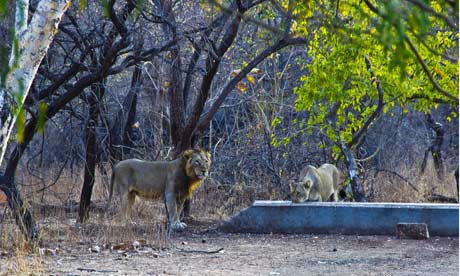
Male and female Asiatic lions drink water in Gir Forest National Park, the threatened species' current habitat. Photograph: Nisarg Lakhmani/Corbis
Ambitious plan to translocate lions from Gujarat to Madhya Pradesh finally gets green light with Supreme Court ruling

Wildlife is under threat in most of India, but there's one state that's clinging to its fauna, if rather too tightly. The state of Gujarat – whose Gir forest shelters the world's only Asiatic lion population – has lost a bitter battle over an ambitious translocation project.

For over 18 years, conservationists have been attempting to move a pride of Gir lions to the Kuno sanctuary in the state of Madhya Pradesh. But the Gujarat government stubbornly refused to let the lions go. Meanwhile, an impatient Madhya Pradesh government bizarrely suggested introducing African cheetahs, whose Asiatic cousin once roamed the area.

Finally, on 15 April, after eight years of litigation, the Supreme Court of India cleared the translocation of the lions, though it said an emphatic no to the cheetahs. Now the reluctant Gujarat government is considering filing a review petition, even as angry locals protest the translocation, some even threatening to kill themselves.

The Gujarat government, and Chief Minister Narendra Modi, have been arguing for years that the Gir lions are the "pride of the state". In court, the lions were described as "family members who could not be parted with." The native Maldhari tribals have lived alongside the lions for years, on the whole peacefully. Even the Supreme Court acknowledged the state's role in saving the lion from an extinction that seemed almost certain only a few decades ago. The latest census put the lion population at 411, up from 359 in 2005.

But most wildlife experts agree that while the state has done well, the lions have outgrown the Gir forest, and a single epidemic or calamity could wipe out the entire population. In 1994, an epidemic of canine distemper killed an estimated 1000 lions in the Serengeti National Park in Tanzania.

"The Gir conservation project has staved off extinction and helped increase population. The translocation is about strengthening conservation prospects and managing success. At the moment, all our eggs are in one basket and that is a huge risk," says Dr Ravi Chellam, well known conservationist and former director of the Wildlife Conservation Society of India. Chellam was one of the experts who recommended the translocation, which he likens to buying life insurance.

In its judgement, not surprisingly, the Supreme Court rejected the Gujarat government's emotional appeal. "The cardinal issue is not whether the Asian lion is a family member, but the preservation of an endangered species," ruled the court, while directing that the lions be moved within six months.

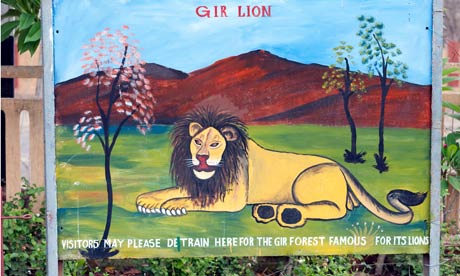
Sign at Sasan Gir Train Station inviting passengers to visit the Gir National Park and Sanctuary in Western Gujarat, India. Photograph: Alamy
Meanwhile, now that the cheetahs have been nixed, the Gujarat government reportedly plans to argue that Kuno is already home to stray tigers from the nearby tiger sanctuary of Ranthambhore. Will two big cats in the same area cause trouble? Most experts say the tiger population in Kuno is too small to make a difference. "Tigers and lions have had overlapping distribution historically. It's still not a good enough reason to deny translocation," says Chellam.

An earlier translocation of lions to the state of Uttar Pradesh in the fifties failed. With insufficient prey and only a small area to roam, the lions hunted nearby village cattle, and were hunted in their turn by angry villagers. This time around, conservationists say things will be different. "Kuno was chosen because of its size-3000 sq km-and diverse prey base. Lions need lots of space, plenty of prey, and protection from people," says Chellam. Wildlife studies have shown that the prey count in Kuno is actually higher than that of Gir. 24 villages were relocated in Kuno, at considerable expense, to make way for the lions, though many villagers complain that they have still not received compensation.

Despite the years of preparation, the hard work has only just begun. Indeed, Kuno is a test case for conservation through translocation. Kuno has a strong gun culture, and the Supreme Court has agreed that forest staff will need to be trained and deployed to prevent poaching. Locals will need to be educated, involved and given a stake in conservation, just as the Maldharis had. The project will need male lions to be moved from Gir to Kuno every three to five years for the next 30 years.

All this means that Gujarat will very soon have to stop sulking and start cooperating. After nearly 20 years of bickering and debate, it's time to put everything else aside and act to save the Asiatic lion.

Source: http://www.guardian.co.uk/environment/terra-india/2013/may/07/india-acts-asiatic-lion-moving

Who started the fire?

M R Manjunath, May 7, 2013, DHNS

Come summer, and State’s reserves face the problem of forest fires. Most of these fires are manmade, and are triggered either by vested interests or by accident. The reasons are many, and so are the methods. 


Dandeli, Nagarhole, Bandipur, Biligirirangana Betta and Kudremukh are the State’s most well-known sanctuaries, which are also tiger reserves. These forest regions are known for their rich biodiversity, from many varieties of trees including sandalwood and honne to a host of medicinal plants. Apart from tigers, the wildlife in these forests include elephants, sambars, deer, bears, langurs, Malabar squirrels, etc.

Come summer, there’s invariably the problem of forest fires. While natural forest fires are part of nature’s cycle, there are other forest fires that are sometimes triggered by man.

Forest fires that occur at a time when the region is already facing drought spells double-trouble for wildlife. The Bandipur region is facing one of its worst droughts ever this year, with all the water bodies having gone dry.

Bamboo, which is present in the forest regions of the State, blooms once in 40 years. Last year and the year before that, bamboo in the State had bloomed. Once the bamboo blooms, it dies. This year, because of the failure of rain, the forest regions in the State are full of dry bamboo. There are elements that misuse such a scenario to trigger a fire. According to forest authorities, the months from February to May call for extra vigil. The reasons for manmade fires are many.

Most forest reserves adjoin agricultural land. Sometimes, farmers trigger fires because they believe that grass growth will improve later, and will provide adequate grazing space for cattle. Then, there is the fear of monkey fever that raises it head during summer. People believe setting fire in the forest could solve that problem. Also, there is the problem of poaching. Poachers and small-time hunters often set fire to leaves because they need to enter the forest stealthily. They try and prevent the rustling of dry leaves when they step on them in the forest, by burning leaves. Tourists inadvertently trigger a forest fire when they throw cigarette stubs. Also, locals looking for honey and non-timber forest produce (NTFP) could set fire in the forest. Then, there are those seeking to avenge punishment meted out to them by the Forest Department, for having chopped trees for firewood. The reasons are many, and the methods are many as well. Forest watchers strive hard to bring the fire under control. The incident of a woman wage worker slipping and falling into the fire when she was trying to douse a fire in the Dandeli forest may be recalled here. The woman succumbed to burns.

It was not too long ago when an incident of some elements triggering a fire in Kulagi range of Dandeli occurred. The Forest Department, on its part, says it is trying its best to create awareness about forest fires and what they do to the ecosystem. Also, to combat drought conditions, the Department has also built percolation pits in the Bandipur region to supply water to wildlife.

Source: http://www.deccanherald.com/content/330710/who-started-fire.html

Monday, 6 May 2013

Contour canal for Parambikulam project turns death trap for wildlife

P. OPPILI, The Hindu

Canal runs to a distance of nearly 50 km: naturalists

  • The project is maintained by the State Public Works Department
An open contour canal constructed during the 1960s for the Parambikulam Aliyar Project in Coimbatore district has become a death trap for wildlife in the Anamalai Tiger Reserve (ATR), Pollachi.

Naturalists and environmentalists say the canal runs to a distance of nearly 50 km, of which a 45-km stretch passes through the ATR.

During seasonal migration and dry periods, elephants, tigers, leopards, sloth bears, wild dogs, Indian Gaur, sambhar deer and spotted deer come to the canal for drinking water. If the animals fall into the canal, it would be difficult to rescue them.

The Project is maintained by the State Public Works Department, which began refurbishing the canal as there were many leaks in it. The work began nearly a year ago.

A. Rangarajan, Secretary, Tamil Nadu Green Movement, said his organisation had sent a letter to the Central Empowered Committee (CEC) demanding a joint inspection of the place with representatives from the PWD, Forest Department and the National Board for Wildlife. The CEC had also sent a letter to the Chief Secretary to arrange for a site inspection.

However, nothing has been done in this regard, Mr. Rangarajan charged. He said the canal, apart from fragmenting the forest, leads to death and maiming of wildlife, which will be more than a dozen annually.

The Forest Department had divided the 49-km canal into eight stretches and conducted a survey.

During the survey, officials recorded the presence of at least half a dozen species of wildlife along the stretch.

Making provisions for the wildlife to cross over from one side to the other is the recommendation for the first stretch which begins from the Power House till the entrance of the tunnel 1; the second stretch is the entrance of the tunnel 1 where the recommendation was to erect railings.

The other recommendations included installing scalable slopes and railings to prevent wildlife from falling into the canal and facility for wildlife to access water along the canal.

When contacted, wildlife authorities said they have requested the PWD to provide platforms to facilitate animals to drink water safely from the canal.

Similarly, they have given a few designs to the PWD authorities, which would help the wildlife cross the canal without any problem.

“Wildlife concerns are well taken care of by the department,” a senior official added.

Source: http://www.thehindu.com/todays-paper/tp-national/contour-canal-for-parambikulam-project-turns-death-trap-for-wildlife/article4685389.ece

Villagers lynch wild bear that killed 8 persons

  • The wild bear started attacking villagers from Saturday
  • It may have been lured out of the forest by the smell of cashew apples and mahua flowers: Forest officials
A wild bear that killed eight persons and injured five persons in the past 24 hours was lynched by villagers in the Kotpad area of Koraput district on Sunday.

The injured were first admitted to the Kotpad Community Health Centre. Later they were shifted to the Koraput district hospital.

According to police sources, the deceased included two women.

Forest officials said a team from the Nandankanan Zoological Park in Bhubaneswar was called in to capture the errant bear by using tranquilisers. Before the team could reach Koraput, the bear faced the wrath of angry villagers.

Villagers upset

The villagers had been upset with the killings by the bear. They had even staged a dharna in front of the forest ranger’s office in Kotpad. They blocked roads at several places in Kotpad.

The villagers tracked down the bear near the Girla village before the forest officials could capture it alive. Eyewitnesses said the animal was first hit by a jeep. Then it was beaten to death by the mob. They then carried the carcass in a procession in Kotpad.. Later, the forest officials seized the carcass.

Laxmikant Mishra, Divisional Forest Officer, and sub-collector Birendra Karkara rushed to the area and promised compensation to the families of victims. They also assured proper treatment of the injured.

Forest officials said the bear might have strayed out of the jungle lured by the smell of cashew apples and mahua flower. Consumption of mahua might have intoxicated the bear following which it could have turned violent.

On Saturday, the bear attacked a group of women returning after collecting firewood from the jungle near Amarmunda village. The animal was hiding under a culvert. One woman was killed on the spot. When people gathered in the area, it bear ran away. Later, it attacked and killed two others near Amarmunda and Totiaguda.

A couple sleeping outside their house were attacked by the animal. The husband died on the spot while his wife died in the hospital. Two other persons of the same village were attacked the same night. The body of another person killed by the bear at Girla was found on Sunday morning.

Source: http://www.thehindu.com/todays-paper/tp-national/villagers-lynch-wild-bear-that-killed-8-persons/article4687577.ece

Voter trampled by elephant

A person, on his way to cast his vote, was trampled to death by an elephant at Phalguni village in Mudigere taluk on Sunday morning.

The deceased Nasir Khan (60), an agriculture labourer, had left his residence after telling his wife that he was going out to vote. He is survived by his wife. The couple had no children.

Deputy Conservator of Forests Raviraj Narayan visited the spot after receiving the information.

He told The Hindu that the elephant had trampled him to death and threw a wooden log on his body.

“His wife told us that he went out around 6.30 a.m. to cast his vote. As he did not return till 10 a.m., people went to search for him. Later they found him dead,” he said.

Source: http://www.thehindu.com/todays-paper/tp-national/tp-karnataka/voter-trampled-by-elephant/article4687935.ece

Sunday, 5 May 2013

Leopardess found killed near Mysore

Lawrence Milton, TNN May 5, 2013
MYSORE: A two-year-old leopardess in Mysore appears to be killed and its paws have been removed by miscreants near Hunsur on Sunday.

The leopard was found dead at one Puttamma's land near Pakshirajapura in Hunsur forest range. The cause for its death is not known. Visceral samples have been sent to Institute of Animal Health and Veterinary Biological in Mysore to establish the cause of death.

The incident came to light early on Sunday of the landlady Puttamma noticed the big cat lying dead.

An official said the leopardess carcass is still fresh and suspect it may have been killed for claws as all its limbs have been cut off with a weapon. There are no external injuries over the body.

Hunsur forest territory DCF Vijaykumar told TOI that three days back we got a complaint from residents of Pakshirajapura that a leopard is on prowl near their village and south forest department's help. We later placed a cage with dog as bait. But we found the leopard dead a few metres away from the cage on Sunday morning. However, the dog is alive.

There is no injury over its body and we believe it could have died of starvation, claims the DCF.

To a query, Vijaykumar said some miscreants may have removed after its death and as of now we have no evidence of poaching the animal. However, we are investigating to go deep into the incident because this is for the first time claws of the leopard have been removed. We have filed a police case, the DCF stated.

Source: http://articles.timesofindia.indiatimes.com/2013-05-05/mysore/39042113_1_leopardess-dcf-forest-department

Friday, 3 May 2013

Deer run over by suburban train at Saidapet

Pratiksha Ramkumar, TNN May 3, 2013
CHENNAI: A deer was run over by a train near the Saidapet suburban railway station late Thursday night.

The animal, suspected to be around four-years-old, was trying to cross the railway track at around midnight, when one of the last EMU trains crushed it to death. Police suspect that the deer could have strayed away from Raj Bhavan. The Raj Bhavan sits inside a sprawling green campus and has a sizeable deer population.

The animal was found on the South side of the station by the railway police force (RPF), who gave up trying to rescue it, as it seemed to have died on the spot. "It did not seem to breathe, it was like a carcass," said sub inspector Maharajan of the RPF. Police authorities, took the body back to the Saidapet station and handed it over to forest department officials on Friday morning.

The forest department did not confirm the possibility of a post mortem being done on the animal.

Source: http://articles.timesofindia.indiatimes.com/2013-05-03/chennai/39008024_1_railway-track-rpf-forest-department

Monday, 29 April 2013

Buying land to return it to nature

Ananda Banerjee,  Live Mint

Some government, non-government bodies, individuals are trying to push back against relentless development

WTI purchased 26 acres of land along the Thirunelli-Kudrakote corridor in Kerala to restore the degraded habitat
and protect wildlife. Photo courtesy WTI
Given the relentless pace at which wildlife habitat is being devoured by the march of development, some government agencies, non-governmental organizations and individuals have been trying to push back—by buying land and letting nature reclaim it.

The past decade has seen a conscious effort to secure wildlife habitats to protect forests.
A recent exercise involved the purchase of 26 acres along the Thirunelli-Kudrakote wildlife corridor in the Wayanad district of Kerala that comes under the watch of the non-profit Wildlife Trust of India (WTI). In the past few months, camera traps have recorded three tigers crossing the corridor.

The land was purchased by WTI with the help of the World Land Trust (WTL), IUCN-Netherlands and the Elephant Family to restore the degraded habitat and protect wildlife along the stretch. The 38 families in four villages in the area were relocated to an alternative site. The exercise cost in excess of Rs.2 crore.

Corridors between two sanctuaries (protected areas) are absolutely critical to wildlife for species dispersal, allowing exchange of individuals between populations and preventing inbreeding, among other ecosystem linkages. The land bought by WTI is gradually being handed over to the Kerala forest department for incorporating it as part of the Wayanad Wildlife Sanctuary.

The Thirunelli-Kudrakote corridor connects the Brahmagiri Wildlife Sanctuary (18,100 hectares) bordering Karnataka and Kerala, with the Wayanad Wildlife Sanctuary (11,000 hectares) and the Wayanad north division (21,400 hectares) in Kerala. The stretch is part of a larger swathe of about 12,000 sq. km, with an elephant population of more than 6,300. This by itself constitutes one-third of India’s endangered Asian elephant population, which keeps moving up and down the corridor for food and social bonding.

Buying land back from the villagers has not only secured the corridor for the safe passage of elephants and other wild animals, but also helped reduce human-elephant conflict in the area.

“The people are able to harvest and are spared sleepless nights guarding their crop and houses from elephants,” said Sandeep Tiwari, deputy director, WTI. “The initiatives have also helped in improving the lives of these families as they now have access to education and healthcare centres and opening up employment opportunities.”

How much forest is cut down for development needs? The government’s 11th Plan (2007-12) was particularly severe in terms of loss of forest cover, according to a report by research and activist group Centre for Science and Environment (CSE). Land was diverted for development projects with scant consideration for wildlife, water and rural communities, it said.

The CSE study looked at five key sectors—thermal power, hydropower, cement, iron and steel, and mining—that have impacted forests. The report said 8,284 projects were granted forest clearance and 197,907.61 hectares of forest land diverted between 2007 and 2011. In the past three decades, 815,534.48 hectares of forest have been cleared for 23,404 projects (see graphic).

India is urbanizing rapidly, and there is heavy pressure on land and natural resources as the population increases. According to a study by the Associated Chambers of Commerce and Industry of India (Assocham), the number of towns has grown from 5,161 to 7,935 in the decade ended 2011, and this may near 10,000 by 2030. Demographic projections show that by then, the proportion of people in urban areas may swell to more than double that in rural areas.

The loss of forest habitat is a reason for declining wildlife populations across the planet. In this scenario, buying land to secure wildlife habitats has given conservationists a method to arrest habitat loss. As renowned conservation biologist Richard Cowling said: “Conservation is 10% science and 90% negotiation.”

Acquiring land for conservation is not new. In the book Buying Nature, authors Sally K. Fairfax, Lauren Gwin, Mary Ann King, Leigh Raymond and Laura A. Watt document the process of land acquisition as a conservation strategy in the US in the last 200 years.
One such current initiative is the American Prairie Reserve, a collaborative effort involving conservation agencies such as the World Wide Fund for Nature (WWF) and the National Geographic Society that aims to acquire land in north-eastern Montana in the US to create a seamless protected area.

“Imagine a grassland reserve of three million acres—a wildlife spectacle that rivals the Serengeti and an awe-inspiring place for you and your children to explore,” says the American Prairie Reserve website.

“Imagine helping to build a national treasure.”

Eric Dinerstein, lead scientist and vice-president, conservation science, WWF, said: “By 2022, I dream of 10,000 bison thundering across 1,000,000 acres with wolves in hot pursuit.”

Back in India, between 2001 and 2003, WTI managed to secure the Kollegal or Edayarhalli–Doddasampige elephant corridor for about Rs.70 lakh. The elephant range to the east of the Biligirirangan Hills had been divided by a long strip of cultivation that cut off the Biligiriranga Swamy Temple (BRT) Wildlife Sanctuary from the forests of the Kollegal division. A narrow corridor now exists between the villages of Kurubaradoddi and Aandipalya along the Kollegal-Satyamangalam highway.

WTI acquired 25.4 acres for the corridor in Aandipalya village from 17 landowners. The land has been transferred to the Karnataka forest department through a formal memorandum of understanding (MoU) to maintain it as an elephant corridor, ensuring connectivity and incorporating it as part of the BRT Wildlife Sanctuary. This is the first ever privately bought corridor to be added to a protected areas in Asia.

In the North-East, with financial support from WLT, which pioneered the buy-an-acre concept of acquiring land for conservation, WTI is working with the Garo Hills Autonomous District Council (GHADC), the Meghalaya state forest department and the local community to secure wildlife corridors and the restore wildlife habitat.

As much as “4,150 acres have been secured with notification of 10 Village Reserve Forests,” said WTI’s Tiwari.

WWF-India is keen to follow the model, but rocketing land prices are a stumbling block.
“We are looking across various landscapes to acquire land and hand it over to the forest department,” said Ravi Singh, WWF-India’s secretary general. “Whatever we are doing to get forest land back is being done discreetly as any overt signs may send the land prices spiralling.”


Land for Project Tiger

Project Tiger, the government’s flagship conservation programme that turns 40 years old this month, has secured 2% of the country’s geographical area as tiger reserves. The area under the project gets the highest legal protection under the Wildlife Act. The central government’s programme not only secures the existence of the tiger, but also a gamut of species that thrives in those areas.

Launched in April 1973 in nine reserves across an area of approximately 14,000 sq. km, the project has expanded, especially in the past decade, from 25 tiger reserves in 2001 to 43 now. Project Tiger has secured an area of 66,274.68 sq. km across 17 states in the country.

Under the project, the central government provides 100% monetary assistance to states for strengthening protection; creating basic infrastructure for management; habitat development and restoration; water resources; eco-development programmes; village relocation; use of information technology (IT) in crime detection; monitoring of tiger populations; and carrying out estimations of tigers, co-predators and prey animals among others.

Private forests

Apart from government and non-government initiatives, a few individuals too have acquired land adjoining wildlife sanctuaries across the country and then allowed natural forest regrowth to take place as part of conservation. Most of them refused to speak on record.

One of them is Romulus Whitaker, popularly known as the Snake Man of India for his specialization in reptiles.

Whitaker set up the Agumbe Rainforest Research Station (ARRS) in Karnataka as a field station for the study of rainforest ecology in 2005 on a four-acre plot surrounded by forests. The land was bought with money willed to him by his mother, Doris Norden Chattopadhyaya.

Agumbe is a village in the Western Ghats in Shimoga where, in 1971, Whitaker spotted his first king cobra. He’d always wanted to set up a research base in the area.

In 2005, Whitaker also received the prestigious Whitley Fund for Nature award, which helped him set up basic infrastructure and convert an old farmhouse into a full-fledged forest research base.
“During the setting up of the field station, we had visits from leopards as well as a couple of king cobras, which to us ‘certified’ the place as the ideal field station,” he recalled.
Today, ARRS has 10 acres of land thanks to additional acquisitions and recently came under the administration of the Madras Crocodile Bank Trust, which Whitaker set up in the 1980s to study reptiles.

Wildernest, in the Chorla Ghat area of Goa, has secured 450 acres and is perhaps one of the largest private reserve corridors for forests across two sanctuaries as well as two states—between the Mhadei Wildlife Sanctuary in Goa and Bhimgad Wildlife Sanctuary in Karnataka. The Wildernest team runs two independent research stations like ARRS, one in the Chorla ghats and the other at Kuveshi near Castle Rock.

The Sai Sanctuary located in the Western Ghats is another example of a private forest reserve. It’s home to large carnivores such as tigers and leopards, along with elephants and 300 species of birds.

From the initial purchase of 55 acres of private forested lands in 1991, the reserve managed by the Sai Sanctuary Trust has grown to more than 300 acres and today offers a buffer to the National Parks and Wildlife Sanctuaries along its borders—Brahmagiri, Nagarhole and Bandipur.

Securing land, especially degraded forests and leaving them for nature to reclaim, is a sustainable model to restore forests and protect biodiversity. But it’s an uphill task with land costs surging the moment there’s a hint of demand. Also, in a burgeoning economy in which development is the buzzword, it can be a struggle to find the right balance between conservation and economic growth imperatives.

Source: http://www.livemint.com/Politics/df1ep278rRHJ7JaeI6ohrL/Buying-land-to-return-it-to-nature.html

Wednesday, 24 April 2013

Elephant electrocuted near Kuppam

Accidentally trapped in a live-wire fence erected to keep off wild bores
The mysterious deaths of wild elephants continues unabated in the Kaundinya sanctuary at the confluence of the Andhra, Tamil Nadu and Karnataka border, about 125 kms from here in the Palamaner-V.Kota-Kuppam tract.

In the most recent case, forest officials found the carcass of a full-grown female elephant on Monday at Vengampalle in Byreddypalle mandal. After conflicting reports as to the cause of the pachyderm’s death, further reports said that the autopsy conducted by veterinary surgeons in the presence of forest officials on Tuesday indicated that the jumbo must have died after coming into contact with a live-wire.

Source: http://www.thehindu.com/todays-paper/tp-national/tp-andhrapradesh/elephant-electrocuted-near-kuppam/article4648926.ece

Monday, 22 April 2013

Before the last trumpet

Sreedhar Vijayakrishnan | Down To Earth

Captive elephants of Kerala suffer because there is no proper policy for their management and welfare

Out of the 100-odd elephant attacks reported during the
last festive season of 2011-2012, at least a dozen were
the result of the animal being in the state of musth
It is that time of the year again when the streets of Kerala echo with clinking of chains. Massive caparisoned tuskers, some carrying idols, rush from one festival to the other.

The association of these "gentle giants", as they are known to writers and poets, with humans has been there for centuries. The earliest possible evidence of taming elephants in India goes back to the Indus valley civilization. Most of our ancient texts, from Ramayana to Arthashastra, talk about elephants being part of wars and arenas. There are also texts like Matangalila detailing the qualities an elephant should possess to be part of the royal stable.

They used to be a symbol of pomp and pride in the past. Today they are seen as a source of revenue. About 70 per cent elephants in the state are owned by individuals who rent out the animal for festivals and processions for huge sums of money. Temple committees and fans of “celebrity” elephants compete to line up the best elephants, and in their passionate involvement, welfare of the animal takes a backseat. They are so extravagant that they are even ready to pay six digit figures to get their favourite elephant for a day, making captive elephant management a multi-million rupee business. Except for a few temples, most prefer male elephants, specifically tuskers, for ceremonies, which may be attributed to their aesthetic value. Ironically, it is the male elephant that most often goes out on a rampage and creates havoc.

Every year, between December and May, which is the festive season in Kerala, an elephant takes part in 100 to 120 festivals extending over 150-200 days. Assuming that the average distance between each festival is 50 km, an elephant travels more than 5,000 km during the period. Worse, most elephants are transported by trucks, which adds to their psychological trauma. In the last three to four years, at least half a dozen elephants were injured or killed in truck accidents. Besides, this is the time when bull elephants enter a state of increased testosterone known as musth and show highly aggressive behaviour. Out of the 100-odd elephant attacks reported during the last festive season of 2011-2012, at least a dozen were the result of the animal being in the state of musth. Photographs of these elephants that featured in major dailies clearly showed temporal gland secretion, a clear indication of musth. Despite such conspicuous evidence, the law and its guardians remain blindfolded. At least 100 people were injured in these attacks; the maximum number of injuries were reported at the much renowned Thrissur Pooram temple festival. Enquiries and public questionnaires were conducted, but to no avail.

This year also similar mishaps have been reported. On January 27, three innocent women were killed by a much celebrated tusker of Kerala, Thechikottukavu Ramachandran. It is also the tallest captive elephant in the country. The incident happened about 10 days after his becoming musth. It was a good move by the forest department to “arrest” the elephant and keep it under custody till further notification. The latest fatal attack happened on February 7, when Vaazhakkalayil Mothi Prasad killed a girl at Alappuzha. Between January 1 and the first week of February, there have been 26 incidents of elephants running amok all over Kerala.

Elephant attacks are not inevitable and can be prevented with conscious involvement and sensibility.

To bring atrocities towards captive elephants to an end, the Kerala Captive Elephant Management rules were framed in 2003. Though first of its kind in India and perhaps the world, the Act like most other government policies is gathering dust. Insertion of microchips for monitoring movement and health conditions of elephants, and ensuring vehicular transportation are probably the only rules that have been implemented so far. However, it seems as if these rules were implemented to minimise the time taken from one location to another, and thereby moving the pachyderm to more workplaces.

The rules state that no elephant in musth shall be put to work and has to be secured properly. This is hardly followed. The number of elephants in musth state that wreak havoc during festivals is evidence enough. Although revised in December 2012, the new rules seem to be much relaxed. For example, clause (16) states sedatives may be administered to elephants if they are nervous. This allows owners to administer sedatives to musth elephants and put them to work.

Although the raison d’être of the rules was betterment of pachyderm management in captivity, lack of its proper enforcement is still a matter of concern. Unless that is ensured, the elephantine problem will only exasperate.

Though there are a very few traditional mahouts left in Kerala, they do not see a ray of hope anymore in captive elephant management. Their revelations of the clandestine operations happening in the field are appalling. Death toll due to intestinal obstruction and other digestive problems has increased from one or two in a year to a whopping 10. This certainly must be a result of potential increase in physiological and psychological stress. Most mahouts admit working continuously for 35-40 days during peak festive season, without a break, which means sleepless nights for the animal. Some mahouts also disclose the administration of anti-androgen tablets to elephants to arrest musth. This seems to have now led to drastic changes in the musth patterns or even absence of musth in several bulls. Absence of musth causes an imbalance in the physiological cycle of the animal, thereby leading to more distress.

Current state minister of forests, K B Ganesh Kumar, has been part of captive elephant management sector for a long time in various capacities. He must implement the management rules aptly to address the problem. Keeping a check on the number of festivals that an elephant is taken for and the distance it travels will also contribute to mitigating conflict. This can be ensured with appropriate decisions from the Forests and Wildlife Department.

Interestingly in October 2010, the Union Ministry of Environment and Forests declared the Asian elephant as National Heritage Animal. While the wild counterparts are dwindling in numbers due to habitat fragmentation and poaching, the captive ones are vanishing too. Let’s keep our fingers crossed that a day does not come when the national heritage animal is confined to postal stamps, wall papers and posts on social networking sites.

Sreedhar Vijayakrishnan works with WCS-India Programme, National Centre for Biological Sciences in Bengaluru

Source: http://www.downtoearth.org.in/content/last-trumpet

Sunday, 21 April 2013

Leopard attack creates panic

The Hindu | April 22, 2013
Killing of a calf by a leopard has made villagers of Bonthapally in Jinnaram mandal of Medak district jittery on Sunday.

According to sources, a farmer Veeraswamy had tied his calf in the farm yard and gone for lunch. When he returned, he found his calf killed by some wild animal.

Forest officer Ravi visited the spot and confirmed that the calf was indeed killed by a leopard. The villagers felt that wild animals have been entering the villages, as there was no drinking water available in the forest areas.

Source: http://www.thehindu.com/todays-paper/tp-national/leopard-attack-creates-panic/article4641836.ece

Saturday, 20 April 2013

Unruly nilgais on dangerous bull run

Shobha John, TNN | Apr 20, 2013
Nilgais come under Schedule III of the Wildlife Act.
NEW DELHI: Gujarat is still smarting over the loss of some of its Gir lions to Madhya Pradesh. But many states would gladly give away an animal whose burgeoning population is causing havoc in farms, airforce stations and on national highways — the blue bull or nilgai. So fraught has this man-animal face-off become that Bihar issued an order on February 19 for culling these animals in a restricted way.

For Rahul Gupta (name changed), a nilgai will always evoke trepidation. Recently, as he was driving down a national highway at 9 pm, a blue apparition suddenly jumped in front of his luxurious car. It was a nilgai -- big, agile and just as bewildered as Gupta. The car crashed, the bonnet crumpled. Fortunately, the airbags saved him. "But it will cost me Rs 22 lakh to repair the car," says Gupta. He was lucky. Last April, a toddler and his father were killed when their Santro turned turtle on ramming into a nilgai in Gurgaon.

Nilgais also raid farms and damage crops. "Poor farmers existing on subsistence agriculture can ill-afford this and are increasingly hostile to them," says Dr N P S Chauhan, head of population management, Wildlife Institute of India, Dehradun. "After introduction of the Wildlife Protection Act (1972), many wildlife species, including nilgais, have increased considerably outside protected areas," says Chauhan in a research paper. This leaves crops as the only food available to them, says Bittu Sahgal, editor, Sanctuary Asia. Also, the decrease in predators -- wolves and jackals -- has further increased their numbers.

Nilgais, incidentally, come under Schedule III of the Wildlife Act. "Basically, this means that if a state government, under political pressure, wants to issue permissions to shoot nilgais, they can," says Sahgal. Constant skirmishes led the chief wildlife warden in Bihar to constitute a committee to issue licenses to kill them in a restricted way. The February 19 order states that the license to use stipulated firearms for culling will be valid for four weeks, that Rs 500 will be paid for each killing and Rs 1,000 for disposal of the body. Culling has also taken place in other states such as HP, MP and Gujarat.

Air force stations, too, are frequented by nilgai herds and use choppers to scare them away. Former group captain Pankaj Chopra says, "When I was the chief commanding officer of a forward station, I saw a nilgai and a MiG colliding on the runway. The plane turned turtle. We had a tough time extricating the pilot. The plane was written off." In 2008, an AI flight hit a nilgai at Chakeri airport in Kanpur. All escaped unhurt.

So what's the solution? "One should restore ecosystems so that the predator-prey ratio gets balanced," says Sahgal. "In the US where virtually every predator has been shot, humans have taken on this role and are turning the guns on animals." How about fencing highways or relocating them like the Gir lions, asks Gupta.

Easier said than done.

(Inputs from Madan Kumar in Patna)
Source: http://timesofindia.indiatimes.com/home/environment/flora-fauna/Unruly-nilgais-on-dangerous-bull-run/articleshow/19642514.cms

Friday, 19 April 2013

How elephants see the world

ANI | April 20, 2013
Washington: 12 to 14 year old students from East Side Middle School in New York City are attempting to put an end to the elephant crisis, which is at an all time high with more and more demand for ivory taking more and more lives.

Think Elephants International, a not-for-profit organization striving to promote elephant conservation through scientific research, education programming and international collaborations, today announced its latest study, "Visual Cues Given by Humans are Not Sufficient for Asian Elephants (Elephas Maximus) to Find Hidden Food." 

Designed in collaboration with and co-authored by students from East Side Middle School, the study revealed that elephants are not able to recognize visual cues provided by humans, although they are more responsive to vocal commands.

These findings may directly impact protocols for future efforts to conserve elephants, which are in danger of extinction in this century due to increased poaching and human/elephant conflict.

The publication of this paper is the climax of a three-year endeavor to create a comprehensive middle school curriculum that educates and engages young people directly in elephant and other wildlife conservation.

The study was carried out at Think Elephants' field site in northern Thailand, and students participated via webcam conversation and direct web-links to the elephant camp.

According to Joshua Plotnik, PhD, founder and CEO of Think Elephants, "if elephants are not primarily using sight to navigate their natural environment, human-elephant conflict mitigation techniques must consider what elephants' main sensory modalities are and how elephants think so that they might be attracted or deterred effectively as a situation requires. The loss of natural habitat, poaching for ivory, and human-elephant conflict are serious threats to the sustainability of elephants in the wild. Put simply, we will be without elephants, and many other species in the wild, in less than 50 years if the world does not act."

The Think Elephants study tested whether captive elephants, wild animals in relatively close contact with humans, could follow visual, social cues (pointing and gazing) to find food hidden in one of two buckets.

The elephants failed at this task, but were able to follow vocal commands telling them which bucket contained the food.

These results suggest that elephants may navigate their physical world in ways that primates and dogs do not.

Based on the results of this study, Dr. Plotnik suggests further attention to research on elephant behavior and an increase in educational programming are needed, particularly in Asia where the market for ivory is so strong.

The study has been published in the journal PLOS ONE.

Source: http://zeenews.india.com/news/eco-news/how-elephants-see-the-world_843388.html

PM urged to announce special package to address man-animal conflict

TNN | Apr 19, 2013
NAGPUR: Following unprecedented rise in man-animal conflict in which eight villagers were mauled by a problem leopard in 25 days, Prime Minister Manmohan Singh has been urged to announce a special package to implement 'alternate livelihood programme' for minor forest produce (MFP) and livestock dependent families living in Tadoba landscape and wildlife corridors.

Satpuda Foundation, which is a member of the National Board for Wildlife (NBWL), has demanded a special package from the Prime Minister, who is also the chairman of NBWL. In a letter to the PMO on Wednesday, the Satpuda Foundation chief Kishor Rithe said that there are at least 189 spots in TATR landscape where there is presence of big cats.

Explaining the problem, Rithe said that communities living in Tadoba's buffer villages and wildlife corridors mostly depend on MFP like bamboo, mahua flowers and tendu leaves for livelihood. Wild animals, who are not so familiar with humans, tend to attack villagers who enter the forest to collect these forest produce or to graze livestock.

From 2007 to 2013, around 83 human deaths and around 5,861 cattle kill cases have been recorded in Chandrapur district alone, as against 223 human and 21,775 cattle kills in the entire state.

The Satpuda Foundation has sought PMO's intervention to implement preventive steps rather than simply paying compensation.

"It is high time, that a special package to solve man-animal conflict is implemented under alternate livelihood programme for MFP," said Rithe. The Satpuda Foundation will also write to MLAs and MPs in Vidarbha to gather support to design and implement such package.

The copy of the letter has also been sent to Jayanthi Natarajan, Union environment and forest minister, and Montek Singh Ahluwalia, deputy chairman of Planning Commission.

Trail of death

* March 24: Anusaya Shende, Usrala Chak (Saoli)
* April 6: Dhrupada Madavi, Sadagad (Saoli)
* Leopard caged and released in Girghat (TATR)
* April 10: Tukaram Dharne and Malan Munghate ((Adegaon)
* April 10: (Wrong leopard caged)
* April 11: Lalita Pendam (Pathri)
* April 12: Nileema Kotrange (Chorgaon)
* April 17: Kirti Katkar (Payali)
* April 18: Gopika Kalsarpe (Kitali)

(Six deaths after release of problem leopard in TATR. On April 16 Laijabai Fukat was killed by a tiger in Ranbodi in Umred-Karhandla)

Source: http://timesofindia.indiatimes.com/city/nagpur/PM-urged-to-announce-special-package-to-address-man-animal-conflict/articleshow/19623792.cms