Showing posts with label WCS. Show all posts

Wednesday, 8 May 2013

After Mhadei find, tiger expert on big cat trail in Cotigao


TNN | May 8, 2013
PANAJI: A team of experts led by noted conservation zoologist Kota Ullas Karanth has commenced work on a comprehensive tiger survey in the Cotigao wildlife sanctuary and other protected areas after the recent success of the camera trap method.

The Goa government had recently cleared the decks for an intensive survey and within a few weeks of the go-ahead the forest department had captured a tigress on camera within the limits of the Mhadei Wildlife Sanctuary.

The extensive study, which will extend for four years till 2017, will rely on refined protocols such as camera trap findings to assess the presence of the big cat and the prey base in Goa's forests.

"He (Karanth) has given a list of 45 spots in different sanctuaries to lay camera traps and line transects for the survey," said Richard D'Souza, principal chief conservator of forests. While the expert will conduct the study, the forest department will also independently do its work, especially in Mhadei.

The protected areas of Cotigao, Neturlim, Molem national park, Bondla and Mhadei form a contiguous corridor with tiger areas in Karnataka.

The tiger estimation done by the forest department in the past has shown the presence of tigers. Three had been counted in 1993, five in 1997 and 2002.

Though the forest department had been in a denial syndrome for a long time earlier, things have changed recently with significant findings.

"This vindicates the stand taken by some officials and animal lovers who have claimed the big cats' existence here for more than a decade and a half," a source said.

Referring to the work being done in the protected areas over the last few days D'Souza said, "This is the actual groundwork for the survey."

Goa's protected areas have been identified as a tiger conservation unit (TCU) along with the contiguous forest areas of Karnataka and Maharashtra in a study by international organizations.

The World Wide Fund International, US Fish and Wildlife Services and Wild Life Conservation Society, New York, in a study had categorized the Western Ghats as the second best tiger habitat in India after the Sunderbans in West Bengal.

Source: http://timesofindia.indiatimes.com/city/goa/After-Mhadei-find-tiger-expert-on-big-cat-trail-in-Cotigao/articleshow/19942067.cms

Tuesday, 7 May 2013

India acts to save Asiatic lion by moving it – but hard work has only just begun

Kavitha Rao | Tuesday 7 May 2013 
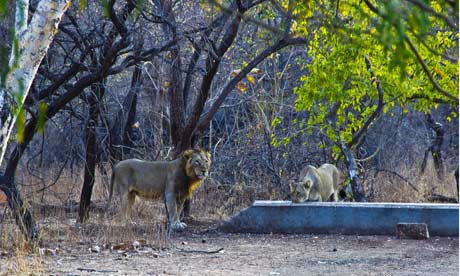
Male and female Asiatic lions drink water in Gir Forest National Park, the threatened species' current habitat. Photograph: Nisarg Lakhmani/Corbis
Ambitious plan to translocate lions from Gujarat to Madhya Pradesh finally gets green light with Supreme Court ruling

Wildlife is under threat in most of India, but there's one state that's clinging to its fauna, if rather too tightly. The state of Gujarat – whose Gir forest shelters the world's only Asiatic lion population – has lost a bitter battle over an ambitious translocation project.

For over 18 years, conservationists have been attempting to move a pride of Gir lions to the Kuno sanctuary in the state of Madhya Pradesh. But the Gujarat government stubbornly refused to let the lions go. Meanwhile, an impatient Madhya Pradesh government bizarrely suggested introducing African cheetahs, whose Asiatic cousin once roamed the area.

Finally, on 15 April, after eight years of litigation, the Supreme Court of India cleared the translocation of the lions, though it said an emphatic no to the cheetahs. Now the reluctant Gujarat government is considering filing a review petition, even as angry locals protest the translocation, some even threatening to kill themselves.

The Gujarat government, and Chief Minister Narendra Modi, have been arguing for years that the Gir lions are the "pride of the state". In court, the lions were described as "family members who could not be parted with." The native Maldhari tribals have lived alongside the lions for years, on the whole peacefully. Even the Supreme Court acknowledged the state's role in saving the lion from an extinction that seemed almost certain only a few decades ago. The latest census put the lion population at 411, up from 359 in 2005.

But most wildlife experts agree that while the state has done well, the lions have outgrown the Gir forest, and a single epidemic or calamity could wipe out the entire population. In 1994, an epidemic of canine distemper killed an estimated 1000 lions in the Serengeti National Park in Tanzania.

"The Gir conservation project has staved off extinction and helped increase population. The translocation is about strengthening conservation prospects and managing success. At the moment, all our eggs are in one basket and that is a huge risk," says Dr Ravi Chellam, well known conservationist and former director of the Wildlife Conservation Society of India. Chellam was one of the experts who recommended the translocation, which he likens to buying life insurance.

In its judgement, not surprisingly, the Supreme Court rejected the Gujarat government's emotional appeal. "The cardinal issue is not whether the Asian lion is a family member, but the preservation of an endangered species," ruled the court, while directing that the lions be moved within six months.

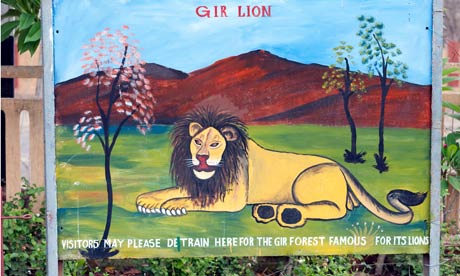
Sign at Sasan Gir Train Station inviting passengers to visit the Gir National Park and Sanctuary in Western Gujarat, India. Photograph: Alamy
Meanwhile, now that the cheetahs have been nixed, the Gujarat government reportedly plans to argue that Kuno is already home to stray tigers from the nearby tiger sanctuary of Ranthambhore. Will two big cats in the same area cause trouble? Most experts say the tiger population in Kuno is too small to make a difference. "Tigers and lions have had overlapping distribution historically. It's still not a good enough reason to deny translocation," says Chellam.

An earlier translocation of lions to the state of Uttar Pradesh in the fifties failed. With insufficient prey and only a small area to roam, the lions hunted nearby village cattle, and were hunted in their turn by angry villagers. This time around, conservationists say things will be different. "Kuno was chosen because of its size-3000 sq km-and diverse prey base. Lions need lots of space, plenty of prey, and protection from people," says Chellam. Wildlife studies have shown that the prey count in Kuno is actually higher than that of Gir. 24 villages were relocated in Kuno, at considerable expense, to make way for the lions, though many villagers complain that they have still not received compensation.

Despite the years of preparation, the hard work has only just begun. Indeed, Kuno is a test case for conservation through translocation. Kuno has a strong gun culture, and the Supreme Court has agreed that forest staff will need to be trained and deployed to prevent poaching. Locals will need to be educated, involved and given a stake in conservation, just as the Maldharis had. The project will need male lions to be moved from Gir to Kuno every three to five years for the next 30 years.

All this means that Gujarat will very soon have to stop sulking and start cooperating. After nearly 20 years of bickering and debate, it's time to put everything else aside and act to save the Asiatic lion.

Source: http://www.guardian.co.uk/environment/terra-india/2013/may/07/india-acts-asiatic-lion-moving

Monday, 22 April 2013

Before the last trumpet

Sreedhar Vijayakrishnan | Down To Earth

Captive elephants of Kerala suffer because there is no proper policy for their management and welfare

Out of the 100-odd elephant attacks reported during the
last festive season of 2011-2012, at least a dozen were
the result of the animal being in the state of musth
It is that time of the year again when the streets of Kerala echo with clinking of chains. Massive caparisoned tuskers, some carrying idols, rush from one festival to the other.

The association of these "gentle giants", as they are known to writers and poets, with humans has been there for centuries. The earliest possible evidence of taming elephants in India goes back to the Indus valley civilization. Most of our ancient texts, from Ramayana to Arthashastra, talk about elephants being part of wars and arenas. There are also texts like Matangalila detailing the qualities an elephant should possess to be part of the royal stable.

They used to be a symbol of pomp and pride in the past. Today they are seen as a source of revenue. About 70 per cent elephants in the state are owned by individuals who rent out the animal for festivals and processions for huge sums of money. Temple committees and fans of “celebrity” elephants compete to line up the best elephants, and in their passionate involvement, welfare of the animal takes a backseat. They are so extravagant that they are even ready to pay six digit figures to get their favourite elephant for a day, making captive elephant management a multi-million rupee business. Except for a few temples, most prefer male elephants, specifically tuskers, for ceremonies, which may be attributed to their aesthetic value. Ironically, it is the male elephant that most often goes out on a rampage and creates havoc.

Every year, between December and May, which is the festive season in Kerala, an elephant takes part in 100 to 120 festivals extending over 150-200 days. Assuming that the average distance between each festival is 50 km, an elephant travels more than 5,000 km during the period. Worse, most elephants are transported by trucks, which adds to their psychological trauma. In the last three to four years, at least half a dozen elephants were injured or killed in truck accidents. Besides, this is the time when bull elephants enter a state of increased testosterone known as musth and show highly aggressive behaviour. Out of the 100-odd elephant attacks reported during the last festive season of 2011-2012, at least a dozen were the result of the animal being in the state of musth. Photographs of these elephants that featured in major dailies clearly showed temporal gland secretion, a clear indication of musth. Despite such conspicuous evidence, the law and its guardians remain blindfolded. At least 100 people were injured in these attacks; the maximum number of injuries were reported at the much renowned Thrissur Pooram temple festival. Enquiries and public questionnaires were conducted, but to no avail.

This year also similar mishaps have been reported. On January 27, three innocent women were killed by a much celebrated tusker of Kerala, Thechikottukavu Ramachandran. It is also the tallest captive elephant in the country. The incident happened about 10 days after his becoming musth. It was a good move by the forest department to “arrest” the elephant and keep it under custody till further notification. The latest fatal attack happened on February 7, when Vaazhakkalayil Mothi Prasad killed a girl at Alappuzha. Between January 1 and the first week of February, there have been 26 incidents of elephants running amok all over Kerala.

Elephant attacks are not inevitable and can be prevented with conscious involvement and sensibility.

To bring atrocities towards captive elephants to an end, the Kerala Captive Elephant Management rules were framed in 2003. Though first of its kind in India and perhaps the world, the Act like most other government policies is gathering dust. Insertion of microchips for monitoring movement and health conditions of elephants, and ensuring vehicular transportation are probably the only rules that have been implemented so far. However, it seems as if these rules were implemented to minimise the time taken from one location to another, and thereby moving the pachyderm to more workplaces.

The rules state that no elephant in musth shall be put to work and has to be secured properly. This is hardly followed. The number of elephants in musth state that wreak havoc during festivals is evidence enough. Although revised in December 2012, the new rules seem to be much relaxed. For example, clause (16) states sedatives may be administered to elephants if they are nervous. This allows owners to administer sedatives to musth elephants and put them to work.

Although the raison d’être of the rules was betterment of pachyderm management in captivity, lack of its proper enforcement is still a matter of concern. Unless that is ensured, the elephantine problem will only exasperate.

Though there are a very few traditional mahouts left in Kerala, they do not see a ray of hope anymore in captive elephant management. Their revelations of the clandestine operations happening in the field are appalling. Death toll due to intestinal obstruction and other digestive problems has increased from one or two in a year to a whopping 10. This certainly must be a result of potential increase in physiological and psychological stress. Most mahouts admit working continuously for 35-40 days during peak festive season, without a break, which means sleepless nights for the animal. Some mahouts also disclose the administration of anti-androgen tablets to elephants to arrest musth. This seems to have now led to drastic changes in the musth patterns or even absence of musth in several bulls. Absence of musth causes an imbalance in the physiological cycle of the animal, thereby leading to more distress.

Current state minister of forests, K B Ganesh Kumar, has been part of captive elephant management sector for a long time in various capacities. He must implement the management rules aptly to address the problem. Keeping a check on the number of festivals that an elephant is taken for and the distance it travels will also contribute to mitigating conflict. This can be ensured with appropriate decisions from the Forests and Wildlife Department.

Interestingly in October 2010, the Union Ministry of Environment and Forests declared the Asian elephant as National Heritage Animal. While the wild counterparts are dwindling in numbers due to habitat fragmentation and poaching, the captive ones are vanishing too. Let’s keep our fingers crossed that a day does not come when the national heritage animal is confined to postal stamps, wall papers and posts on social networking sites.

Sreedhar Vijayakrishnan works with WCS-India Programme, National Centre for Biological Sciences in Bengaluru

Source: http://www.downtoearth.org.in/content/last-trumpet

Tuesday, 2 April 2013

Can you get a degree in wildlife in India?

Shamala Kittane Subramanyan

Yes, you can, but only in namma Bengaluru! In the second of our 3-part series, look at the NCBS and how it’s innovating on research in the biological sciences.

"We are a pure science research institute that focuses on biological sciences but we are also probably the only institute that recognises the need to diversify. We have students from engineering and technology backgrounds taking up Ph.D courses with us," says Dr. Mukund Thattai, Professor (Computational cell biology) capturing the essence of the National Centre for Biological Sciences in Bangalore, an offshoot of the Tata Institute of Fundamental Research (TIFR).
NCBS Campus. Pic courtesy: ncbs.res.in
Students have to appear for an entrance exam held by TIFR which is a common exam for about seven institutes : TIFR, CDFD, NBRC, CCMB, NCCS, TCIS and NCBS.

"The exam is balanced. It's not just knowledge-based but tests students on their logical thinking and problem solving skills. This increases the scope for students from disciplines other than the pure sciences to compete," reveals Thattai.

Out of all the students that appear for the exam to get into TIFR, about 9000 students apply to NCBS alone. 200-250 applications are selected for the next round which comprises a three day intensive interview with the researchers at NCBS. About 35 students are taken into the institute and with a 30 member faculty. it makes for a good research partnership.

Students are exposed to all areas of research on a rotational basis in the first six months. The faculty also help students ramp up by supporting them with study sessions on basics of pure science subjects, so that they are able to cope with the rotation classes. After which the students get to choose the research area and begin work on their thesis. After 1.5 years they appear before a Thesis Committee to present their subjects and scope and need to proceed ahead. Most students complete their research in five and half years. "What we are really looking for are students with an open mind that are ready to experiment" says Dr. Thattai.
Pic courtesy: ncbs.res.in
NCBS also hosts innovative annual events such as Hackteria - an intensive two-week transdisciplinary collaboration amongst international and local artists, hackers, activists, scientists, and even artists and designers.

The Institute recognises the current lack of visibility of research being done in such institutes among undergrads and that such visibility could help them make their next big career move. Thus Thattai points out, "We also have summer programs to encourage undergraduate students to intern with us. This could jump-start their research careers"

Research at NCBS

An autonomous institute has come up in the vicinity of the NCBS campus: The Stem Cell Institute. Stem cell is a new field that is gathering momentum in the field of research. "The interaction between faculty at the Stem Cell Institute and NCBS is a further boost to our research studies," says Thattai about all that is happening in the campus.

Dr Annamma Spudich.
Pic courtesy: ncbs.res.in
He also refers to the new dimensions to science brought in by Dr. Annamma Spudich, Scholar in Residence at NCBS, along with Dr. Indhudharan Menon, Professor at NCBS, by capturing the history and tradition of scientific research.

"Asia in the making of Europe," a book by Prof. Donald F. Lach, is one that Dr. Annamma Spudich refers to as she talks about the Indian ethnobotanical knowledge that made India the nexus of world trade during the colonial period. India being blessed with tropical climate was home to rich flora and fauna. Thus biological sciences were not only documented in our ancient scriptures, there is also extensive documentation by Dutch and Portugal scientists and travellers starting early 16th century.


Along with exhibit "Such Treasure and Rich Merchandize: Indian Botanical knowledge in
16th and 17th Century European Books.”, a herbal garden incorporating
50 medicinal plants described in the Hortus Malabaricus was set up at the NCBS.
Pic:courtesy:ncbs.res.in
Dr. Mukund Thattai
Professor, NCBS.
Pic courtesy: ncbs.res.in
Dr. Spudich says "NCBS has tremendous intellectual breadth and its now home to me". She has made a shift from her research career in the field of experimental sciences at Stanford University and is now dedicated to what's closer to her heart, "History of Indian healing traditions". Her work was exhibited at the Cantor Arts Centre, Stanford University in 2003 and also at NCBS in 2008. The exhibition stimulated scholarly and popular interest and was acquired by the Department of Forests and Environment, Govt. of India. It is on view as a permanent exhibit at the Natural History Museum in Mysore. The catalog of the exhibition is available from the NCBS library. (www.ncbs.res.in).

Dr. Thattai himself acknowledges, "20 years ago publishing a research paper in India was difficult, now we have so many well recognised institutes in India that publishing papers from India is as easy now. In fact our standards are equivalent to good institutes abroad and there is also good money for researchers in the field; the only area in which we are falling short is the number of students in India, and especially in Bangalore, who come forward to take up pure sciences as a career."

Unique programme

NCBS also has an M.Sc. programme in Wildlife - in partnership with WCS (Wildlife Conservation Society) and CWS (Centre for Wildlife Studies). The course is announced once in every two years. "Almost every university in the US has courses in wildlife and conservation but not a single one in India offers them." is Dr. Ajith Kumar's (Professor and Course Director, Wildlife Conservation Society) concern. The intake of this programme is 15 students (every two years). "This is a passion driven course and people find their way to us" says Kumar, when asked why the course is not advertised more.

This is proved correct from what Bhanu Sridharan (MSc in Wildlife, 2010-2012) has to share: In 2009, Bhanu walked into the NCBS campus to find out more about the controversial road that was to be laid right through the pristine campus of GKVK (Gandhi Krishi Vigyan Kendra) where NCBS is also located. As her interactions with professors and students at NCBS increased, she was convinced that her bonding with the institute was destined to extend beyond just one story. She eventually enrolled for the Wildlife course. Now, even after she has passed out, NCBS remains her work space "I still work from NCBS; they are informal that way. So alumni can come back, use the libraries or work spaces around here and work," she says.

The Masters programme in wildlife is a fully funded course with a fellowship or stipend every month and the course also covers accommodation and food. They have a separate entrance exam that you have to watch out for on their website. "Most of our students who pass out opt for Ph.D or get involved in organisations working on conservation of wildlife in India and abroad." They have many dissertations and papers to their credit.

Bhanu also expresses her deep gratitude for Ullas Karanth and WCS (Wildlife Conservation Society). Karanth is the one who started the course, raised the funds for it and contacted NCBS. He started out as an engineer and is now amongst some of the well known wildlife conservationists in India and abroad.

Life at NCBS

It is not just unique programmes or innovative research that makes NCBS an exciting place to be in, you are made to feel at ease and the campus is actually so much fun.

"The facilities in NCBS are fantastic. As part of my M.Sc. I did a scuba diving course, " says Bhanu enthisiastically, adding "I also used to be very uninterested in sports, but now I am trying to learn to play squash at the sports complex." She is also taking lessons in a new dance form called zumba, which is being taught on campus by a researcher from Germany.

Inclusivity is another aspect that distinguishes this Institute. As Bhanu explains, "NCBS is open to students from varied backgrounds, as in my case itself - I hold a Bachelors degree in communication studies and getting a fully-funded seat abroad in Wildlife studies would have been difficult. But NCBS gave me that opportunity."

Source: http://bangalore.citizenmatters.in/articles/view/4977-know-more-about-the-national-centre-for-biological-sciences

Thursday, 21 March 2013

Big leopard numbers in human habitats: Study

Amit Bhattacharya, TNN | Mar 21, 2013
File picture of a leopard in Mumbai's Aarey Milk
Colony in 2011. (TOI photo by Hemant Shirodkar)
NEW DELHI: Most people think of leopards as predators that live in forests except for a few that occasionally stray into human settlements. Breaking that myth, a new study has found that a large number of these big cats may be residing in human habitats, quietly sharing space with people in villages, farmlands and even on the edge of towns.

The study was conducted in a densely populated valley in Akole tehsil of Ahmednagar district in western Maharashtra, where researchers set up camera traps in 40 locations for a month to gather evidence of wildlife in this prosperous sugarcane belt.

The results were startling. A total of 81 leopard images were captured across a sampled area of 179 sq km, in which five distinct adult males and six adult females were identified.

Two females were clicked with cubs and a third gave birth six months later — all in an area with a population density of 357 people per square km.

Using a GIS-based software, the researchers estimated animal density at five leopards (4.8) per 100 sq km. That's not all. As many striped hyaenas (5.03/100sq km) were found in the area, taking the number of large predators in the landscape to 10 per 100 sq km. The findings were published on March 6 in the Public Library of Science journal.

"Nowhere in the world have such large number of big predators been reported in such densely populated human landscape," said Vidya Athreya, a wildlife biologist with Wildlife Conservation Society, India, who is the lead author of the study carried out in collaboration with the Maharashtra forest department.

The big cat's density in Akole tehsil was found to be higher than some national parks. In Rajaji, for instance, distribution of leopards is reported to be just 2.07/100 sq km following an increase in tiger numbers. Overall, leopard density in India's protected forests is 15/100 sq km.

Athreya said with the nearest protected forest some 18km away, there was little doubt that the big cats were living in "human areas", mainly in sugarcane fields. "The leopards were marking their territories on roads and on bunds in sugarcane fields. This was as much their land as it was of the people," she said.

During daytime, the felines would sit very still in the fields, often just a few hundred metres from houses. "However, the night made the leopard king. They even went close to houses to kill dogs, cats and goats," Athreya reported.

Akole tehsil is by no means an isolated example. Athreya said leopards can be found across the sugarcane belts of western Maharashtra, Gujarat and western UP, as well as the tea-growing areas of Bengal, Assam and south India.

Remarkably, no human deaths were reported from the study area. Athreya believes this is so because the leopard population in the area is more or less settled. "Leopards instinctively shun humans. That's particularly true of an animal that has grown up in the same area. We found one of our radio-collared leopards visited a particular house every few days without ever disturbing its residents, who sleep in the open," she said.

In contrast, serious leopard attacks were reported from neighbouring forested areas which happen to be close to administrative borders. Athreya believes most of these attacks were because big cats trapped in human habitats were often released in these areas. "A relocated leopard is disoriented and unpredictable," she added.

The study calls for a shift in the concept of conservation, which is focused solely on protected areas. "The presence of big predators in human landscapes throws up challenges which conservationists haven't yet begun to understand," Athreya said.

Source: http://timesofindia.indiatimes.com/home/environment/flora-fauna/Big-leopard-numbers-in-human-habitats-Study/articleshow/19098494.cms

Sunday, 6 January 2013

Community restraint helped save a tiger


Dr Ullas Karanth
Two incidents in the first week of December — first on the fringes of the Wayanad Wildlife Sanctuary in Kerala, followed by the other on the edge of the Nagarahole National Park in Karnataka — have brought the focus back on conflict management in tiger conservation. While in Wayanad, the tiger was shot dead, in North Kodagu, an injured tiger stuck in a barbed wire fence was rescued. These provide contrasting scenarios in conservation. In this interview to Sharath S. Srivatsa, tiger scientist and Director for Science-Asia of Wildlife Conservation Society (WCS) K. Ullas Karanth shares his thoughts on conservation and conflict management in the contiguous forests comprising Bandipur-Nagarahole, Mudu malai and Wayanad, that supports an estimated 150-180 tigers (WCS estimate).

What worked against conservation in Wayanad and in its favour in Nagarahole?

I would not pose it that way. In the next incident, the situation could well get reversed. The key point is, in this case, in Wayanad whipping up of public sentiment based on inflated tiger numbers put out by government, the media frenzy over a few cattle kills which were compensated, and the inability to handle a mob situation led to shooting of a tiger. The information that was available from our scientific data in terms of the “problem” tigers history was ignored, a photo of a tiger already in Mysore Zoo was released to the media as a different problem tiger etc. In the Kodagu case, the village leadership showed restraint and the forest department acted swiftly.

With more effort on tiger conservation, which could result in an increase in the population, do you think such conflicts could occur more often in forest fringes?

Yes, such conflicts on the fringe are in a sense the price we pay for successful tiger population recoveries. You do not have such conflicts in the vast forests of Northeastern hill states, Orissa, Jharkhand, Chhattisgarh etc. because tigers are almost gone or not producing much surplus annually to disperse. With a good prey base, tiger populations produce surpluses regularly. Annual losses in such surplus populations are as high as 20 per cent without reducing densities or numbers. So rational conservation involves such population recoveries as well as dealing with the consequences using the best of science and data — and not just feeling sentimental towards an individual tiger and its fate.

What would be a successful conservation and conflict reduction model in the Bandipur-Nagarahole-Mudumalai-Wayanad block in the Nilgiri Biosphere Reserve?

Basically that model would include
  1. ensuring strict protection of tigers and prey inside the reserves; 
  2. using best possible science to monitor individual tigers and the population status; 
  3. when conflicts occur, promptly compensating livestock losses; 
  4. if human life is threatened removing the problem tigers either through chemical capture or if circumstances warrant it lethal removal; and 
  5. depending on health, age and other objective factors the captured animals should be retained in captivity, or in rare cases released or in specific cases euthanized painlessly. 

The central point is to ensure that tiger populations thrive even if individuals are lost and secondly public support is essential to having core tiger habitats that are strictly protected and support thriving tiger populations.

Source: http://www.thehindu.com/todays-paper/tp-miscellaneous/tp-others/community-restraint-helped-save-a-tiger/article4278475.ece

Tiger count goes up in Karnataka and Tamil Nadu: Wildlife Conservation Society data

Our data base has recorded over 600 individual tigers in past seven years. The total tiger population in Karnataka is about 250 to 300.

Tiger population in India is not dwindling, at least in key reserves in south India where it is actually reaching saturation levels.

In Nagarahole and Bandipur National Parks in Karnataka and bordering areas in Tamil Nadu, tiger populations have reached saturation levels with surplus young tigers spilling out into forests and dispersing through forest corridors. In newer tiger reserves including Bhadra and Kudremukh, numbers have increased by as much as 50 percent.

This has emerged in new global data released by Wildlife Conservation Society (WCS), which is engaged in scientific monitoring and conservation programme in collaboration with government agencies including the National Tiger Conservation Agency.

"The picture is not at all dismal as often projected", said Dr Ullas Karanth, Bangalore-based conservationist who heads Asia operations of WCS. "Scientific monitoring of tiger and prey populations using techniques like Camera Trap, enhanced antipoaching patrols by government agencies and voluntary relocation of people with help from NGOs have helped in boosting tiger numbers significantly".

The Camera Trap project of WCS in Karnaraka, said to be the largest such globally, has helped in scientific monitoring. "Our data base has recorded over 600 individual tigers in the past seven years, and at any given point in time the total tiger population in Karnataka is about 250 to 300", Karanth said.

The overall tiger population densities in Nagarahole-Bandipur have remained high, ranging between 8 tigers per 100 square kilometer to 13 tigers per 100 square kilometres. The prey densities have also been high. "The dispersal and conflict patterns indicate that this population is producing a large surplus every year", he said. Elephants and leopards are among the wild species that share the same landscape.

The monitoring and conservation aspects of the Karnataka model can be emulated in reserves elsewhere though involvement of voluntary groups could vary keeping in view local situation, the veteran conservationist said.

In both states, wildlife staff vacancies have been filled up, patrolling systems have been improved with increased investments and local communities involved in conservation efforts.

It is a technique used to capture images of wild animals without direct human interference. Ordinary cameras are fixed at key points in a reserve, along with infrared sensors that let the camera clock whenever they sense movement in the forest. The locations are changed occasionally because their flash lights alert animals and they start avoiding the area. To distinguish one tiger from another, WCS has developed image processing software which allows speedy and reliable identification of tigers from trap photographs.

Source: http://indiatoday.intoday.in/story/tiger-count-goes-up-in-karnataka-and-tamil-nadu-wcs/1/240283.html