Showing posts with label Supreme Court. Show all posts

Wednesday, 8 May 2013

Road mishap kills bear near Navegaon

Vijay Pinjarkar, TNN | May 9, 2013
NAGPUR: With National Highway Authority of India (NHAI) reluctant to take wildlife protection measures while widening NH-6, a speeding vehicle knocked dead an adult sloth bear close to Shashikiran hills near Dongargaon early Wednesday morning.

"The spot where the bear was crushed falls in Sadak Arjuni range and borders Navegaon wildlife sanctuary. It is single road and a corridor patch. I suspect the animal must be moving towards Navegaon when it was hit," said S V Ramarao, deputy conservator of forests (DyCF), Gondia. Wild animals dying in road hits has become common on NH6, which has been widened from two lanes to four lanes. However, there is not a single patch where NHAI has taken mitigation measures.

On patches between Sakoli and Deori, Wildlife Institute of India ( WII), Dehradun, has suggested mitigation measures like constructing underpasses but this is not acceptable to NHAI, leading to accidents. On January 28, a honey badger (chandi aswal), a rare animal, was knocked dead at the same spot. The Supreme Court has already taken serious view of high mortality of wildlife on roads passing around protected areas (PAs) due to lack of mitigation measures. NHAI is yet to wake up.

Ramarao said the mishap occurred in the wee hours. There is a blind turn at the spot and the speeding vehicle must have hit the bear when it suddenly came out of the bushes to cross the road. The carcass was shifted the Dongargaon forest depot where a post-mortem was performed. Sawan Bahekar, honorary district wildlife warden of Gondia, demanded signboards at vulnerable spots and speed restrictions. "How many more wild animals will keep dying like this," he asked.

Initially officials felt it might be case of poaching but Ramarao said the bear died due to severe internal injuries. The head of the animal was crushed completely and it died on the spot.

Death Dance On NH6

January 7, 2011: A leopard died after being hit by a vehicle near Talegaon ghat under Wardha forest division

May 15, 2011: A full grown leopard knocked dead near Baghnadi between Deori and Rajnandgaon by an unidentified speeding vehicle

Sept 18, 2011: A sambar knocked dead in Duggipar beat under Sadak Arjuni range in Kohmara in Navegaon-Nagzira corridor

On Nov 23, 2011: A full grown leopard knocked dead in the evening near Bazargaon paper mill near Nagpur in Kalmeshwar forest range

Dec 22, 2011: An adult leopard died in road hit near Dongargaon

Jan 6, 2013: A jungle cat found dead near Hardoli, 35km from Nagpur on Amravati Road. The carnivore was hit on its head and died due to excessive bleeding

Jan 28, 2013: A honey badger knocked dead near Dongargaon of Sadak Arjuni forest range in Gondia

Source: http://timesofindia.indiatimes.com/City/Nagpur/Road-mishap-kills-bear-near-Navegaon/articleshow/19959473.cms

Tuesday, 7 May 2013

India acts to save Asiatic lion by moving it – but hard work has only just begun

Kavitha Rao | Tuesday 7 May 2013 
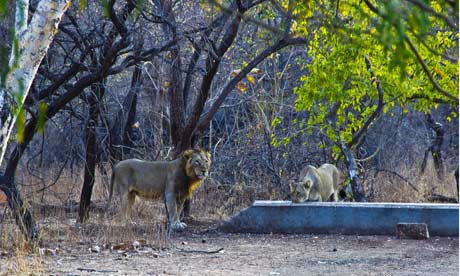
Male and female Asiatic lions drink water in Gir Forest National Park, the threatened species' current habitat. Photograph: Nisarg Lakhmani/Corbis
Ambitious plan to translocate lions from Gujarat to Madhya Pradesh finally gets green light with Supreme Court ruling

Wildlife is under threat in most of India, but there's one state that's clinging to its fauna, if rather too tightly. The state of Gujarat – whose Gir forest shelters the world's only Asiatic lion population – has lost a bitter battle over an ambitious translocation project.

For over 18 years, conservationists have been attempting to move a pride of Gir lions to the Kuno sanctuary in the state of Madhya Pradesh. But the Gujarat government stubbornly refused to let the lions go. Meanwhile, an impatient Madhya Pradesh government bizarrely suggested introducing African cheetahs, whose Asiatic cousin once roamed the area.

Finally, on 15 April, after eight years of litigation, the Supreme Court of India cleared the translocation of the lions, though it said an emphatic no to the cheetahs. Now the reluctant Gujarat government is considering filing a review petition, even as angry locals protest the translocation, some even threatening to kill themselves.

The Gujarat government, and Chief Minister Narendra Modi, have been arguing for years that the Gir lions are the "pride of the state". In court, the lions were described as "family members who could not be parted with." The native Maldhari tribals have lived alongside the lions for years, on the whole peacefully. Even the Supreme Court acknowledged the state's role in saving the lion from an extinction that seemed almost certain only a few decades ago. The latest census put the lion population at 411, up from 359 in 2005.

But most wildlife experts agree that while the state has done well, the lions have outgrown the Gir forest, and a single epidemic or calamity could wipe out the entire population. In 1994, an epidemic of canine distemper killed an estimated 1000 lions in the Serengeti National Park in Tanzania.

"The Gir conservation project has staved off extinction and helped increase population. The translocation is about strengthening conservation prospects and managing success. At the moment, all our eggs are in one basket and that is a huge risk," says Dr Ravi Chellam, well known conservationist and former director of the Wildlife Conservation Society of India. Chellam was one of the experts who recommended the translocation, which he likens to buying life insurance.

In its judgement, not surprisingly, the Supreme Court rejected the Gujarat government's emotional appeal. "The cardinal issue is not whether the Asian lion is a family member, but the preservation of an endangered species," ruled the court, while directing that the lions be moved within six months.

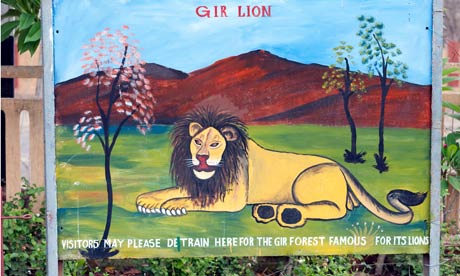
Sign at Sasan Gir Train Station inviting passengers to visit the Gir National Park and Sanctuary in Western Gujarat, India. Photograph: Alamy
Meanwhile, now that the cheetahs have been nixed, the Gujarat government reportedly plans to argue that Kuno is already home to stray tigers from the nearby tiger sanctuary of Ranthambhore. Will two big cats in the same area cause trouble? Most experts say the tiger population in Kuno is too small to make a difference. "Tigers and lions have had overlapping distribution historically. It's still not a good enough reason to deny translocation," says Chellam.

An earlier translocation of lions to the state of Uttar Pradesh in the fifties failed. With insufficient prey and only a small area to roam, the lions hunted nearby village cattle, and were hunted in their turn by angry villagers. This time around, conservationists say things will be different. "Kuno was chosen because of its size-3000 sq km-and diverse prey base. Lions need lots of space, plenty of prey, and protection from people," says Chellam. Wildlife studies have shown that the prey count in Kuno is actually higher than that of Gir. 24 villages were relocated in Kuno, at considerable expense, to make way for the lions, though many villagers complain that they have still not received compensation.

Despite the years of preparation, the hard work has only just begun. Indeed, Kuno is a test case for conservation through translocation. Kuno has a strong gun culture, and the Supreme Court has agreed that forest staff will need to be trained and deployed to prevent poaching. Locals will need to be educated, involved and given a stake in conservation, just as the Maldharis had. The project will need male lions to be moved from Gir to Kuno every three to five years for the next 30 years.

All this means that Gujarat will very soon have to stop sulking and start cooperating. After nearly 20 years of bickering and debate, it's time to put everything else aside and act to save the Asiatic lion.

Source: http://www.guardian.co.uk/environment/terra-india/2013/may/07/india-acts-asiatic-lion-moving

Wednesday, 17 April 2013

Why New Home Can Save India’s Lions

By Saptarishi Dutta
Asiatic Lions, Gujarat, Madhya Pradesh

Conservationists say splitting India’s small population of Asiatic lions will help prevent the endangered animal from being wiped out.

India’s Supreme Court on Monday ruled that some of the 411 Asiatic lions that live exclusively in Gir Forest in Gujarat state will be moved to Kuno Palpur Wildlife Sanctuary in Madhya Pradesh.

“I am all in favor of it,” said M. K. Ranjitsinh, chairman of the Wildlife Trust of India, a non-governmental organization. “They should have a second home,” he added.

Experts argue restricting the lions to a single geographical area puts them at greater risk of extinction.

“If they are hit by a disease, there is a possibility that the entire population could be wiped out,” said Belinda Wright, founder of the Wildlife Protection Society of India.

“It is best for the species that a second and third location is established,” Ms. Wright added, warning of the risk of extinction.

“India would be a devastated place without this incredible cultural and heritage symbol,” she said.

The court said the lions will move to Madhya Pradesh within the next six months. A special panel comprising wildlife experts will decide how many lions will be move to Kuno Palpur, one of the most suitable habitats in India for Asiatic lions, according to a study by the Wildlife Institute of India.

The court’s ruling puts an end to a long-running interstate dispute. Gujarat has been reluctant to let go of a share of its lion population, a major tourist attraction in the state.

Around 460,000 tourists visited the Gir Forest in 2012 generating revenues of 50 million rupees ($914,745) for Gujarat’s forest department, according to Sandeep Kumar, a forest official at Gir.

The government of Gujarat had opposed the relocation of any of its lions to Madhya Pradesh, citing rampant poaching there.

According to Madhya Pradesh’s forest department, there are between 250 and 300 cases of poaching of all types of animals in Madhya Pradesh every year.

Asiatic lions are smaller than their African counterparts, and have visible ears and a thinner mane. Asiatic lions also have a thicker elbow tufts and a longer tail tuft.

While dividing the lion population between two states will likely help conservation efforts, experts say other worries remain.

Lions have difficulty finding enough to eat, as their prey – mainly deer and antelopes – is frequently killed by humans. “This is an overriding problem throughout India,” Ms. Wright said.

The loss of natural habitat through deforestation caused by a rising human population is also detrimental to the lion population, said Naresh Kadyan, Indian representative of International Organization for Animal Protection, a body affiliated to the United Nations.

Madhya Pradesh Chief Minister Shivraj Singh Chouhan welcomed the court’s decision: “I welcome Supreme Court’s verdict on Asiatic Lions. We are well-equipped to welcome them in their new home. #MP,” he wrote on Twitter on Monday.

Follow Saptarishi and India Real Time on Twitter @saptarishidutta and @indiarealtime.

Source: http://blogs.wsj.com/indiarealtime/2013/04/16/why-new-home-can-save-indias-lions/

Monday, 1 April 2013

Power project stuck as TN fails to constitute wildlife board

K A Shaji, TNN Apr 1, 2013
COIMBATORE: Tamil Nadu's failure to constitute a State Board for Wildlife (SBWL) is posing problems for at least three major projects mooted by the AIADMK government, including the much anticipated 2X500MW Coal-based Thermal Power Plant at Tuticorin.

According to top sources in the Union ministry of environment and forests, three proposals that came up for clearance were turned down at a recent meeting of the standing committee for National Board for Wildlife (NBWL), which said these were submitted directly by the state without getting the mandatory approval of the state board. The committee then found that Tamil Nadu was the only one state in the country that had not constituted the SBWL. Like NBWL, which frames wildlife protection policies at the national level, SBWL is expected to undertake the task at the state level. Any project that could have an impact on a protected wildlife area has to get the clearance of both SBWL and NBWL.

The refusal of NBWL to discuss the Tuticorin power plant mooted jointly by Neyveli Lignite Corporation Limited and the state department of power happens at a time when Tamil Nadu is facing an extraordinary energy crisis. According to NBWL standing committee member and senior wildlife scientist A J T Johnsingh, there is no option left before the state government other than to constitute SBWL at the earliest. The NBWL clearance is mandatory for the Tuticorin project as it comes within the 10 km periphery of Mullakadu range of forests.

Proposals for a bridge on Chennai-Pulicat Road and a fish landing centre at Periyamongagodu near Thiruvallur are similarly stuck as NBWL standing committee has refused clearance. While 1.11 hectare of forest land from Pulicat Bird Sanctuary will have to be transferred for constructing the bridge on Pasiyavaram Road, the fish landing centre needs 0.65 hectare of forest land from the same sanctuary. NBWL will look at the proposals only after these are cleared by its state counterpart. "According to Section-6 of the Wildlife Protection Act 1972 (amended in 2006), each state government is bound to constitute a state board for wildlife under the chairmanship of the chief minister or administrator in the case of a Union territory. It is a curious case that Tamil Nadu is lacking such a board. It is high time the state government constituted the board as interests of wildlife must be protected while undertaking bigger development projects,'' said K Mohan Raj of Tamil Nadu Green Movement.

According to Johnsingh, Uttarakhand was giving Tamil Nadu company till last year. "But that state constituted the board in 2012 leaving Tamil Nadu as the only one without the board. Setting up the SBWL will help boost conservation and ensure protection of forest wealth. The Supreme Court has stressed the importance of review of projects by such a board on a number of occasions. The nation board can decide on projects only on the basis of the findings of the state board,'' he said.

Sources in the ministry said NBWL members, Kishore Rithe, Prerna Singh Bindra, M K Ranjit Singh and N Madhusudan, expressed concern that Tamil Nadu has approached the national body without even constituting its local board.

Source: http://articles.timesofindia.indiatimes.com/2013-04-01/coimbatore/38188792_1_nbwl-sbwl-state-board

Monday, 4 March 2013

Notice to Centre, States on protecting elephants from rail accidents

  • Train accidents account for 37 p.c. elephant deaths
  • Train accidents claim lives of eight to ten elephants annually
The Supreme Court on Monday issued notice to the Centre, the Railways and 11 States including Tamil Nadu, Karnataka and Kerala on a public interest writ petition for a direction to take effective steps for protecting elephants from being killed in rail accidents.

A Bench of Justices K.S. Radhakrishnan and Dipak Misra issued notice on a petition filed by Shakti Prasad Nayak challenging the inaction of the Union Ministry of Environment and Forests, Indian Railways and various States in containing the widespread number of deaths of elephants on railway track either due to electrocution or being hit by trains.

The petitioner said train accidents claimed the lives of eight to ten elephants annually and since 1987, over 110 elephants had been killed in train accidents.

He said train accidents accounted for 37 per cent of elephant deaths in the country.

The petitioner said he made representations to the authorities concerned to take steps to protect the elephants from such accidents but no drastic step seemed to have been taken. Hence the present writ petition for a direction to the Centre and states to take immediate steps to prevent such accidents.

Source: http://www.thehindu.com/todays-paper/tp-national/notice-to-centre-states-on-protecting-elephants-from-rail-accidents/article4477287.ece

Tuesday, 26 February 2013

SC: Why not ban vehicles in forests for animal safety?

Dhananjay Mahapatra, TNN | Jan 19, 2013
NEW DELHI: Concerned by high animal mortality in traffic accidents on roads passing through thick forests, the Supreme Court on Friday issued notices to the Centre and 10 states asking why mitigating measures, including a dusk-to-dawn ban on vehicles on forest roads, be not taken immediately.

Amicus curiae Harish Salve moved the application before the court's green bench comprising Justices Aftab Alam, K S Radhakrishnan and Ranjan Gogoi. He pointed to the disturbing number of deaths because of "upgradation, widening or indiscriminate construction of new roads through areas which have thick forest and which are rich in wildlife without first putting in place mitigative measures".

Salve mentioned the high incidence of death of animals, which collide with vehicles on the 54-km stretch of NH 37 passing through Kaziranga (a world heritage site recognized by Unesco) to escape flood waters of Brahmaputra in their attempt to flee towards higher grounds of Karbi Anglong forests.

A study by the ministry of environment and forests (MoEF) eight years ago suggested construction of seven underpasses and 100-150 metre long ecoduct (tunnel) through raised grounds for safe passage of animals without their coming to the road. "The MoEF and the Assam government have not yet taken any steps to implement the recommendation," Salve complained.

The amicus said the apex court had in 2009 banned heavy and commercial vehicle movement on a state highway passing through Sariska tiger reserve and a ban on all vehicular movement during the night. This order is yet to be implemented, he said.

Salve said the apex court had in November 2008 closed traffic at night on the Mysore-Mananthawadi road passing through Nagarhole national park and ordered putting speed regulating measures like rumble strips.

He said roads were being indiscriminately constructed or upgraded even in ecologically sensitive areas like national parks and sanctuaries without seeking permission from competent authorities under the Wildlife Protection Act.

"These roads, besides jeopardizing wildlife, are also exposing pristine areas having high rainfall in the evergreen forests of the Western Ghats and the Himalayas which are prone to soil and water erosion and are subjected to other adverse impacts on the flora and fauna," he said.

The application listed important roads passing through sanctuaries and national parks or areas with heavy concentration and movement of wildlife requiring putting in place site-specific mitigation measures to prevent and reduce wild animal deaths from vehicular accidents.

On the benefit of mitigation measures, Salve gave the example of Zanzibar (East Africa), where installation of just four speed-breakers helped reduce mortality of the threatened red colobus monkeys by 85% in the first nine months.

Closure of roads from dusk to dawn, or from 9 pm till 7 am, has become necessary, Salve said. "This has been done between Mysore and Ooty, which passes through two protected areas with very high concentration of wildlife - the Bandipur national park in Karnataka and Mudumalai wildlife sanctuary across the border in Tamil Nadu," he added.

Source: http://timesofindia.indiatimes.com/india/SC-Why-not-ban-vehicles-in-forests-for-animal-safety/articleshow/18081130.cms

Wednesday, 20 February 2013

MoEF extends deadline for states to declare eco-sensitive zones around wildlife parks and sanctuaries

Kumar Sambhav S

It is the last opportunity for states, warns ministry official

The Union Ministry of Environment and Forests (MoEF) has extended the deadline for the states to declare eco-sensitive zones  around national parks and wildlife sanctuaries by three more months. The previous deadline expired on February 15.

Eco-sensitive zones are the ecologically important areas designated to be protected from industrial pollution and unregulated development under the Environment Protection Act of 1986. In 2002, MoEF had decided to declare an area of 10 km from the boundaries of protected areas as eco-sensitive zones to create a buffer around them. But many states opposed it, fearing it would hamper development. The decision was challenged in the Supreme Court. In 2005, MoEF, on the recommendation of the National Board of Wildlife (NBWL), decided that states will declare eco-sensitive zones on site-specific, case-to-case basis, and that industrial activity in such zones would be regulated instead of being prohibited. Till the time these zones are not notified, all projects that require environmental clearance and fall within 10 km of the boundary of a protected area were to be placed before NBWL’s standing committee for approval.

The ministry has sent several reminders to states to propose eco-sensitive zones. It formulated guidelines to declare area-specific eco-sensitive zones in February 2011, but not many states forwarded proposals. India has 102 national parks and 515 wildlife sanctuaries, but till January this year, only seven eco-sensitive zones were notified around protected areas. In the meanwhile, the Central Empowered Committee (CEC) that advises the Supreme Court on forest matters suggested that such zones should be limited to up to two kilometres from the boundary of the national parks. It said this would expedite the process of declaring the eco-sensitive zones. The ministry, however, did not buy this argument and advocated the existing mechanism of declaring site-specific safety zones around each protected area or restricting industrial activity within 10 km from its boundary in case such zones are not identified (see ‘Smaller eco zone irks ministry’).

Later, the ministry issued directions to the states on December 31, 2012, giving them the deadline of February 15 to send proposals for site-specific eco-sensitive zones around the protected areas. It said if the proposals were not sent for particular protected area by the deadline, the restrictions on industrial development will be imposed in an area of 10 km around that protected area. As the states panicked and started preparing the proposals, communities living around several protected areas in the country started protesting against the declaration of these zones. Reports from Maharashtra, Goa and Madhya Pradesh suggest people feared that notification of such zones would hamper their development.

While many states have formed committees of forest department and environmentalists to identify eco-sensitive zoones, it seems not many of them could comply with the deadline of February 15. “The states have requested for more time. Preparation of proposals has progressed well in several states but it is pending approval at the state governments' level. We have given them a last opportunity by extending the deadline for three more months,” said an official in the MoEF.

Source: http://www.downtoearth.org.in/content/moef-extends-deadline-states-declare-eco-sensitive-zones-around-wildlife-parks-and-sanctuari

Monday, 21 January 2013

Supreme Court bans tourists from taking trunk road passing through Jarawa area in Andamans

J. VENKATESAN

Order follows Andaman and Nicobar Administration’s January 17 notification

In this file photo, a Jarawa woman is being offered some
edibles by a bus passenger on the Andaman Trunk Road
that has been ordered shut for tourists.
Photo: Pankaj Sekhsaria

The Supreme Court on Monday banned tourists from taking the Andaman Nicobar Trunk Road that passes through the area where the Jarawas live. The road is used to reach the Limestone Cave.

The court has already banned all commercial and tourism activities within a five-km radius of the Jarawa Tribal Reserve on the Andaman and Nicobar Islands.

A Bench of Justices G.S. Singhvi and H.L. Gokhale passed the order, taking on record the Andaman and Nicobar Administration’s January 17 notification to comply with the court directives issued last year.

Except 30 villages notified in the schedule, the notification declares a buffer zone of an area up to a five-km radius, adjacent and contiguous to the Jarawa Tribal Reserve Area — starting from the Constance Bay in South Andaman to Lewis Inlet Bay in Middle Andaman. No person shall operate any commercial or tourist establishment directly or indirectly in the buffer zone. Furthermore, no one shall carry out any activity, which may be prejudicial to the safety, security and interests of the Jarawas in any of the settlement villages.

The Bench directed that only government officials, persons residing in the reserve and vehicles carrying essential commodities for the Jarawas would be allowed on the Trunk Road.

Justice Singhvi told counsel, “You provide helicopter service to… tourists to reach the cave as there is a total ban in the buffer area.”

“File affidavit”

The Bench directed the Andaman and Nicobar Administration to file an affidavit, along with a detailed map indicating the areas of Jarawas and settlement of others. It posted the matter for further hearing on February 26.

The October 30, 2007 notification, imposing the ban, was quashed by the Calcutta High Court.

On an appeal, the Supreme Court, stayed the order and asked the administration to strictly enforce the notification till it was considered by the court. This was followed by the January 17 notification.

Source: http://www.thehindu.com/news/national/supreme-court-bans-tourists-from-taking-trunk-road-passing-through-jarawa-area-in-andamans/article4329360.ece