Kavitha Rao | Tuesday 7 May 2013
Ambitious plan to translocate lions from Gujarat to Madhya Pradesh finally gets green light with Supreme Court ruling
Wildlife is under threat in most of India, but there's one state that's clinging to its fauna, if rather too tightly. The state of Gujarat – whose Gir forest shelters the world's only Asiatic lion population – has lost a bitter battle over an ambitious translocation project.
For over 18 years, conservationists have been attempting to move a pride of Gir lions to the Kuno sanctuary in the state of Madhya Pradesh. But the Gujarat government stubbornly refused to let the lions go. Meanwhile, an impatient Madhya Pradesh government bizarrely suggested introducing African cheetahs, whose Asiatic cousin once roamed the area.
Finally, on 15 April, after eight years of litigation, the Supreme Court of India cleared the translocation of the lions, though it said an emphatic no to the cheetahs. Now the reluctant Gujarat government is considering filing a review petition, even as angry locals protest the translocation, some even threatening to kill themselves.
The Gujarat government, and Chief Minister Narendra Modi, have been arguing for years that the Gir lions are the "pride of the state". In court, the lions were described as "family members who could not be parted with." The native Maldhari tribals have lived alongside the lions for years, on the whole peacefully. Even the Supreme Court acknowledged the state's role in saving the lion from an extinction that seemed almost certain only a few decades ago. The latest census put the lion population at 411, up from 359 in 2005.
But most wildlife experts agree that while the state has done well, the lions have outgrown the Gir forest, and a single epidemic or calamity could wipe out the entire population. In 1994, an epidemic of canine distemper killed an estimated 1000 lions in the Serengeti National Park in Tanzania.
"The Gir conservation project has staved off extinction and helped increase population. The translocation is about strengthening conservation prospects and managing success. At the moment, all our eggs are in one basket and that is a huge risk," says Dr Ravi Chellam, well known conservationist and former director of the Wildlife Conservation Society of India. Chellam was one of the experts who recommended the translocation, which he likens to buying life insurance.
In its judgement, not surprisingly, the Supreme Court rejected the Gujarat government's emotional appeal. "The cardinal issue is not whether the Asian lion is a family member, but the preservation of an endangered species," ruled the court, while directing that the lions be moved within six months.
Meanwhile, now that the cheetahs have been nixed, the Gujarat government reportedly plans to argue that Kuno is already home to stray tigers from the nearby tiger sanctuary of Ranthambhore. Will two big cats in the same area cause trouble? Most experts say the tiger population in Kuno is too small to make a difference. "Tigers and lions have had overlapping distribution historically. It's still not a good enough reason to deny translocation," says Chellam.
An earlier translocation of lions to the state of Uttar Pradesh in the fifties failed. With insufficient prey and only a small area to roam, the lions hunted nearby village cattle, and were hunted in their turn by angry villagers. This time around, conservationists say things will be different. "Kuno was chosen because of its size-3000 sq km-and diverse prey base. Lions need lots of space, plenty of prey, and protection from people," says Chellam. Wildlife studies have shown that the prey count in Kuno is actually higher than that of Gir. 24 villages were relocated in Kuno, at considerable expense, to make way for the lions, though many villagers complain that they have still not received compensation.
Despite the years of preparation, the hard work has only just begun. Indeed, Kuno is a test case for conservation through translocation. Kuno has a strong gun culture, and the Supreme Court has agreed that forest staff will need to be trained and deployed to prevent poaching. Locals will need to be educated, involved and given a stake in conservation, just as the Maldharis had. The project will need male lions to be moved from Gir to Kuno every three to five years for the next 30 years.
All this means that Gujarat will very soon have to stop sulking and start cooperating. After nearly 20 years of bickering and debate, it's time to put everything else aside and act to save the Asiatic lion.
Source: http://www.guardian.co.uk/environment/terra-india/2013/may/07/india-acts-asiatic-lion-moving
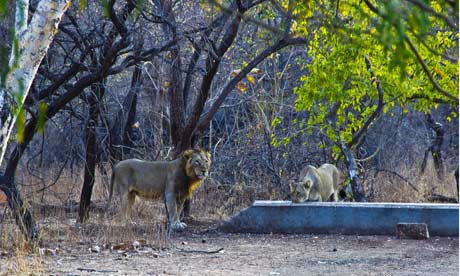 |
| Male and female Asiatic lions drink water in Gir Forest National Park, the threatened species' current habitat. Photograph: Nisarg Lakhmani/Corbis |
Wildlife is under threat in most of India, but there's one state that's clinging to its fauna, if rather too tightly. The state of Gujarat – whose Gir forest shelters the world's only Asiatic lion population – has lost a bitter battle over an ambitious translocation project.
For over 18 years, conservationists have been attempting to move a pride of Gir lions to the Kuno sanctuary in the state of Madhya Pradesh. But the Gujarat government stubbornly refused to let the lions go. Meanwhile, an impatient Madhya Pradesh government bizarrely suggested introducing African cheetahs, whose Asiatic cousin once roamed the area.
Finally, on 15 April, after eight years of litigation, the Supreme Court of India cleared the translocation of the lions, though it said an emphatic no to the cheetahs. Now the reluctant Gujarat government is considering filing a review petition, even as angry locals protest the translocation, some even threatening to kill themselves.
The Gujarat government, and Chief Minister Narendra Modi, have been arguing for years that the Gir lions are the "pride of the state". In court, the lions were described as "family members who could not be parted with." The native Maldhari tribals have lived alongside the lions for years, on the whole peacefully. Even the Supreme Court acknowledged the state's role in saving the lion from an extinction that seemed almost certain only a few decades ago. The latest census put the lion population at 411, up from 359 in 2005.
But most wildlife experts agree that while the state has done well, the lions have outgrown the Gir forest, and a single epidemic or calamity could wipe out the entire population. In 1994, an epidemic of canine distemper killed an estimated 1000 lions in the Serengeti National Park in Tanzania.
"The Gir conservation project has staved off extinction and helped increase population. The translocation is about strengthening conservation prospects and managing success. At the moment, all our eggs are in one basket and that is a huge risk," says Dr Ravi Chellam, well known conservationist and former director of the Wildlife Conservation Society of India. Chellam was one of the experts who recommended the translocation, which he likens to buying life insurance.
In its judgement, not surprisingly, the Supreme Court rejected the Gujarat government's emotional appeal. "The cardinal issue is not whether the Asian lion is a family member, but the preservation of an endangered species," ruled the court, while directing that the lions be moved within six months.
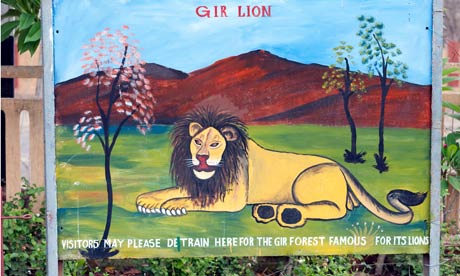 |
| Sign at Sasan Gir Train Station inviting passengers to visit the Gir National Park and Sanctuary in Western Gujarat, India. Photograph: Alamy |
An earlier translocation of lions to the state of Uttar Pradesh in the fifties failed. With insufficient prey and only a small area to roam, the lions hunted nearby village cattle, and were hunted in their turn by angry villagers. This time around, conservationists say things will be different. "Kuno was chosen because of its size-3000 sq km-and diverse prey base. Lions need lots of space, plenty of prey, and protection from people," says Chellam. Wildlife studies have shown that the prey count in Kuno is actually higher than that of Gir. 24 villages were relocated in Kuno, at considerable expense, to make way for the lions, though many villagers complain that they have still not received compensation.
Despite the years of preparation, the hard work has only just begun. Indeed, Kuno is a test case for conservation through translocation. Kuno has a strong gun culture, and the Supreme Court has agreed that forest staff will need to be trained and deployed to prevent poaching. Locals will need to be educated, involved and given a stake in conservation, just as the Maldharis had. The project will need male lions to be moved from Gir to Kuno every three to five years for the next 30 years.
All this means that Gujarat will very soon have to stop sulking and start cooperating. After nearly 20 years of bickering and debate, it's time to put everything else aside and act to save the Asiatic lion.
Source: http://www.guardian.co.uk/environment/terra-india/2013/may/07/india-acts-asiatic-lion-moving