Showing posts with label Mudumalai Tiger Reserve. Show all posts

Saturday, 20 April 2013

Officials, civil society join hands to restore wildlife corridor

Subhash Chandra N S Bangalore | Deccan Herald

Govt declares Kaniyanapura and nearby villages as reserve forest. This is one classic example of how concerted efforts by government officials and civil society can make a difference to conservation. 


Sustained pursuance of the case by a few bureaucrats and wildlife activists has ensured that revenue land, over 5,000 acres, falling in a critical wildlife corridor at Kaniyanapura is declared a reserve forest. The efforts bring to an end the two-decade old issue of protecting the Kaniyanapura elephant corridor - which links Bandipur Tiger Reserve and Mudumalai Wildlife Sanctuary in Tamil Nadu.

Kaushik Mukherjee, former additional chief secretary, B J Hosmath, field director, Project Tiger, Sanjay Gubbi, member, State Board for Wildlife, Basavaraju, assistant commissioner, Kollegal and Manjunath, tahsildar, Gundlupet have together got thousands of acres of revenue land, which had features of forest, declared reserve forest.

“A notification under Section 4 of Karnataka Forest Act has been issued with an intention to provide legal status to this forest patch,” Kumar Pushkar, Chief Conservator of Forests, Bandipur Tiger Reserve, told Deccan Herald. The notification - dated February 2, 2012 - grants reserve forest status to more than 5,000 acres of revenue land to ensure their protection.

Pushkar said the corridor was very important as far as wildlife protection is concerned as almost all animals, including tiger and elephant, use this stretch for their movement. He said declaring such a huge stretch of land as reserve forest was not an easy task. Not doing so would have been a great loss to wildlife as the notified area binds north and south ears of the corridor, he said.

“This area had become a hub of numerous activities. We would have lost the habitat. By declaring it reserve forest, we have secured it for wildlife,” he said.

“This is the patch which connects Biligirirangana Hills Tiger Reserve and Satyamangala forest with Nagarhole and Bandipur,” he added.

The revenue land falling in the limits of Chikyelchetti, Bachalli, Kebbepura, Kaniyanpura, Mangala, Yeriyur, Heggavadi and Kundukere villages have forests that connected the two important protected areas within the Nilgiri Biosphere Reserve.

“Despite a Supreme Court order that land with characteristics of forests should not be diverted for non-forestry activities without proper permissions, several resorts and private farms had come up here. Many of them were illegal and had reduced the corridor to a chicken neck in some locations,” explained a wildlife expert who has conducted a study of this corridor.

Sanjay Gubbi conducted a quick survey of the area with the help of volunteers from Vanya and Aranya wildlife groups in 2011. An area of 9,662.3 acres was found to have forest cover and a report was submitted to the government recommending that these areas be declared reserved forest.

Finding that an area of 5,599.05 acres was not diverted to private use, the department officials made a proposal to the government to declare it reserved forest under the Karnataka Forest Act, 1963. This finally led to the notification declaring the area as reserve forest.

Source: http://www.deccanherald.com/content/257712/officials-civil-society-joi

Sunday, 7 April 2013

Over 12 jumbos die in Mudumalai

DC | B. Ravichandran | 06th Apr 2013
Ooty: While more than a dozen wild jumbos were said to have died due to dehydration and shortage of fodder in the Mudumalai Tiger Reserve (MTR) in recent times, the greens here accuse the MTR administration of poor water management and lack of care for animal health, for the jumbos’ death.

These are not happy times for MTR as the dry weather has been prolonging since December. But, it appears that the MTR administration and chief wildlife warden (CWW) in the state failed to take up the challenge posed by the testing weather to protect the jumbos.

While the official sources in MTR put the jumbo toll around 12, in recent times, S. Jaya­chandran, joint secretary of Tamil Nadu Green Movement (TNGM) said more than 20 jumbos, including the two that died on Friday at the buffer zone, have died over the past three months. “Nobody denies that MTR has been experiencing drought. But, wildlife management can be enhanced. Though the state government and the chief minister show keen interest in wildlife conservation, it is the bureaucrats who lack commitment and mess up things and there is no transparency on animal deaths.”

Though officials in MTR attributed natural causes for the jumbos’ death, it is a fact that they died due to dehydration, lack of fodder and infections caused by contaminated water in slushy pools.

It is learnt that the administration does not have sufficient facilities to provide tanker water in all the vulnerable areas. The TNGM would seek the intervention of the judiciary if the forest officials in Chennai failed to act to set right things in MTR for healthy animal life.

Jayachandran said MTR should learn lessons from the adjacent Bandi­pur tiger reserve in Kar­na­taka where water management is good and the animals are taken care of.

As officials in MTR declined to talk to the media, citing instructions from the CWW, sources said the infighting and factions among the top officials and lack of planning were the reasons for the present situation.

A highly-placed forest department official told DC that the CWW would be instructed to look into the issue.

Source: http://www.deccanchronicle.com/130406/news-current-affairs/article/over-12-jumbos-die-mudumalai

Friday, 22 March 2013

Wild elephants giving their favourite summer haunt a miss

R. KRISHNA KUMAR

Drought has driven many of them away from Kabini backwaters

  • Against nearly 800 in a normal year, the number of elephants has dwindled to about 120 this year
Wild elephants are deserting Kabini backwaters, their favourite summer habitat, as it has run out of water and fodder due to drought.

In a normal year, the famed “annual elephant congregation” begins before summer and lasts till the advent of the southwest monsoon. This year, however, only a few elephants can be found near the backwaters and their numbers are fast dwindling. Herds of elephants are migrating elsewhere in search of greener pasture and more hospitable habitat.

Idyllic spot

Known to be an idyllic spot for the wildlife of both Bandipur and Nagarahole national parks, Kabini backwaters plays host to nearly 600 to 800 elephants in a normal year during peak summer as the moisture in the soil (after the evaporation of water) would be supplanted by fresh green grass which lasts through the season.

Elephants need at least 200 kg of fodder apart from plenty of water, and Kabini backwaters was a veritable paradise for them during summer. But drought has left the place relatively desolated this year.

Located at the junction of Bandipur and Nagarahole, and on the migratory path of wild animals treading to Mudumalai in Tamil Nadu and Wayanad in Kerala, Kabini backwaters used to witness one of the largest wildlife congregations in Asia.

Conservator of Forests Kantharaj, who is also Director of the Bandipur Tiger Reserve, told The Hindu that the number of elephants frequenting the Kabini backwaters this year is less compared with the previous years.

Jungle Lodges and Resorts Ltd. suspended boating in the backwaters about 45 days ago due to lack of enough water in the Kabini backwaters, and also because there were fewer elephant sightings than previous years.

The scenario this year is similar to the drought that affected the region in 2003.

D. Rajkumar, Honorary Wildlife Warden for Mysore district, said that against nearly 800 elephants that could be seen during peak summer in a normal year, their numbers had dwindled to about 90 to 120 this year.

“Moisture in the area is conducive for the growth of green grass and other fodder to sustain a large population of elephant, gaur, sambar, deer and other herbivores animals. But this year, the water stress is high and the moisture content in the soil is not adequate to facilitate the growth of fresh fodder,” Mr. Rajkumar said. In the absence of fodder and water in the area, the elephants have gone to more habitable portions of the national parks, according to Mr. Rajkumar, who is also the local representative of the National Tiger Conservation Authority.

Meanwhile, the authorities are replenishing waterholes every days using tankers.

But this can only meet the requirements of smaller animals to a certain extent. The larger herbivores such as elephants have moved on to the interiors towards Moolehole range, which has received good rain in the last few days.

Source: http://www.thehindu.com/todays-paper/tp-national/wild-elephants-giving-their-favourite-summer-haunt-a-miss/article4540481.ece

Sunday, 17 March 2013

Mudumalai Tiger Reserve reels under drought

D. RADHAKRISHNAN
Unprecedented drought is keeping Forest Department officials on their toes in the Mudumalai Tiger Reserve (MTR) near here.

Threatened by drought: A sambar in the extremely dry
Moyar part of the Mudumalai Tiger Reserve
near Udhagamandalam. -Photo: Special Arrangement
Enquiries made by The Hindu revealed that hitherto, only certain pockets would be affected during the dry months, but this year, practically the entire Reserve extending to over 321 square kilometres wears a parched look.

The situation has become a cause for concern to the Forest Department and environmentalists as the conditions could trigger an outbreak of bushfires. Migration of animals in search of water and fresh vegetation has begun.

Conservationist P.J.Vasanthan said that he was seeing the MTR in such a state for the first time.

Some of the animals he saw were conspicuously emaciated. Many from the Moyar part of the Reserve are coming to the Channel to quench their thirst which flows from Maravakandy to the Moyar Dam. Pointing out that sighting of wild animals in the area has become frequent, he regretted that unscrupulous tour operators were exploiting the situation. In the process, they are disturbing the animals. The prevailing weather conditions have made the surroundings extremely dry and leafless.

Since the situation in the Sigur and Gudalur forests adjoining the MTR was also equally bad, the human-wild animal conflict has escalated and instances of elephants damaging houses are being frequently reported.

Stating that earlier, only about five per cent of the total area were badly affected during the dry season, the Deputy Director, MTR

A.Ameer Haja lamented that this year, even perennial water sources have dried up.

In view of the prevailing situation, a plan of action to deal with any exigency has been put in place.

Officials, including 100 fire watchers, have been instructed to be in a state of alert round the clock. Since the fringe areas along the road which cuts through the reserve are highly vulnerable to bushfires, highway patrol has been intensified.

Five vehicles have been permanently stationed in the Theppakadu, Kargudi, Masinagudy, Mudumalai and Nellakotai ranges of the Reserve to enable the officials to respond quickly to emergencies.

Water tankers have also been stationed at convenient places. In addition to the fire fighting equipment in the MTR, special tools to control fires have been procured from Kerala. Fire lines have been extended. In February, four bushfires had broken out but all of them had been put out before they could cause much damage.

Source: http://www.thehindu.com/todays-paper/mudumalai-tiger-reserve-reels-under-drought/article4520805.ece

Thursday, 7 March 2013

Panel to submit report on private forests by April

P. OPPILI
A high-level committee, comprising officials of the Forest, Agriculture and Revenue Departments, constituted to examine the issues under the provisions of Tamil Nadu Preservation of Private Forests (TNPPF) Act 1949, will submit its report to the government by April.

Forest Department sources said the committee headed by an officer in the rank of Additional Principal Chief Conservator of Forests (Forest Conservation Act) visited 11 districts in the State and recorded the grievances of private patta holders.

The farmers wanted amendments to the existing Act whereby they could look at changing the crop for cultivation, get permission for felling trees in their property, and get permission for sale or lease of their land and growing of crops and trees in their land.

A senior Forest Department official said it was for the first time a high-level committee was formed. The State Forest Minister, while moving the demand for grant for the Forest department for 2012-13, made the announcement that the government will constitute a committee to look into the issues under the TNPPF Act of 1949. The government order issued on September 3, 2012 said the committee must submit its report within four months from the date of issue of this order.

Conservationists and nature lovers have, however, requested the Forest Department to uphold the TNPPF Act 1949. Tamil Nadu Green Movement, in a letter to the Chairman of the Committee, said the Act was enacted to prevent indiscriminate destruction of private forests with the customary and prescriptive rights therein and for certain other purposes.

The Act is important especially in the Nilgiris district, which is rich in floral and faunal diversity, which are highly endemic. Protected areas such as Mudumalai Tiger Reserve and Mukuruthy National Park and crucially important reserve forests of Nilgiri North are flanked by private forests, which offered landscape connectivity to the animals. Environmentalists in the district have constantly relied upon this Act from time to time to prevent illegal activities such as tree felling and construction of buildings.

Reviewing the functionality of the Act with a view to reducing its vigour or to repeal the same at the instance of a few persons, who claimed that they were affected due to implementation of this Act, is purely based on personal and vested interests, the letter said. The Act has been useful in preserving and protecting the forests and tree cover in various parts of the State, the letter noted.

Source: http://www.thehindu.com/todays-paper/tp-national/panel-to-submit-report-on-private-forests-by-april/article4486843.ece

Tuesday, 26 February 2013

SC: Why not ban vehicles in forests for animal safety?

Dhananjay Mahapatra, TNN | Jan 19, 2013
NEW DELHI: Concerned by high animal mortality in traffic accidents on roads passing through thick forests, the Supreme Court on Friday issued notices to the Centre and 10 states asking why mitigating measures, including a dusk-to-dawn ban on vehicles on forest roads, be not taken immediately.

Amicus curiae Harish Salve moved the application before the court's green bench comprising Justices Aftab Alam, K S Radhakrishnan and Ranjan Gogoi. He pointed to the disturbing number of deaths because of "upgradation, widening or indiscriminate construction of new roads through areas which have thick forest and which are rich in wildlife without first putting in place mitigative measures".

Salve mentioned the high incidence of death of animals, which collide with vehicles on the 54-km stretch of NH 37 passing through Kaziranga (a world heritage site recognized by Unesco) to escape flood waters of Brahmaputra in their attempt to flee towards higher grounds of Karbi Anglong forests.

A study by the ministry of environment and forests (MoEF) eight years ago suggested construction of seven underpasses and 100-150 metre long ecoduct (tunnel) through raised grounds for safe passage of animals without their coming to the road. "The MoEF and the Assam government have not yet taken any steps to implement the recommendation," Salve complained.

The amicus said the apex court had in 2009 banned heavy and commercial vehicle movement on a state highway passing through Sariska tiger reserve and a ban on all vehicular movement during the night. This order is yet to be implemented, he said.

Salve said the apex court had in November 2008 closed traffic at night on the Mysore-Mananthawadi road passing through Nagarhole national park and ordered putting speed regulating measures like rumble strips.

He said roads were being indiscriminately constructed or upgraded even in ecologically sensitive areas like national parks and sanctuaries without seeking permission from competent authorities under the Wildlife Protection Act.

"These roads, besides jeopardizing wildlife, are also exposing pristine areas having high rainfall in the evergreen forests of the Western Ghats and the Himalayas which are prone to soil and water erosion and are subjected to other adverse impacts on the flora and fauna," he said.

The application listed important roads passing through sanctuaries and national parks or areas with heavy concentration and movement of wildlife requiring putting in place site-specific mitigation measures to prevent and reduce wild animal deaths from vehicular accidents.

On the benefit of mitigation measures, Salve gave the example of Zanzibar (East Africa), where installation of just four speed-breakers helped reduce mortality of the threatened red colobus monkeys by 85% in the first nine months.

Closure of roads from dusk to dawn, or from 9 pm till 7 am, has become necessary, Salve said. "This has been done between Mysore and Ooty, which passes through two protected areas with very high concentration of wildlife - the Bandipur national park in Karnataka and Mudumalai wildlife sanctuary across the border in Tamil Nadu," he added.

Source: http://timesofindia.indiatimes.com/india/SC-Why-not-ban-vehicles-in-forests-for-animal-safety/articleshow/18081130.cms

Sunday, 10 February 2013

Monkey fever detected in black faced langur in Mudumalai

S M Arun
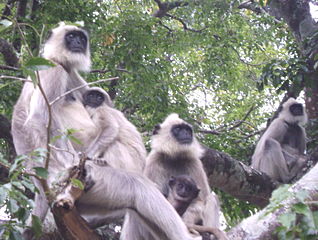
Common Langur or Tufted gray langur
COIMBATORE: For the first time since the discovery of Kyasanur Forest Disease (KFD) or Monkey fever in March 1957, the disease which is endemic in the state of Karnataka has entered Tamil Nadu. A black faced langur found dead in Mudumalai in the Nilgiris could have been infected with the disease, say forest officials. The body of black-faced langur was found a week ago in Mudumalai and the autopsy report revealed that the death was due to the KFD virus. Since it is the first time the presence of the disease is confirmed in Tamil Nadu, health officials in both Nilgiris and Coimbatore districts were put on high alert.

The disease is transmitted by bite of KFD infected ticks and has a mortality rate of 4 % to 15 % in human being; say Indian Council of Medical Research (ICMR) studies. Hunters, forest workers, farmers, campers and trekkers are those who are highly susceptible to the disease as infected ticks could transmit it to humans when they enter forests. They might carry the ticks with them to their homes and it could become epidemic. Coimbatore deputy director of health services Dr R Damodharan said after KFD was reported in Mudumalai, forest department staff in the Nilgiris have been vaccinated against the disease.

"Health officials have been put on alert. So far no KFD incidents have been reported in Coimbatore. We have also intensified the monitoring and surveillance," he said. He said 11 human KFD cases were reported in Gundlupet area recently and one of them succumbed to the disease. The symptoms include fever with bleeding disorders and a reduction in platelet counts, RBC and WBC. "Hospital on wheels and Medical Outreach (MO) Services in tribal areas have been put on alert in Coimbatore-Nilgiri border areas," he added.

Though vaccinations are available against KFD, there is no specific treatment. But, timely supportive therapy reduces mortality in humans. Besides tick bites, humans can get infected by the disease following contact with an infected animal. The disease was named after the forest area where it was discovered. Diagnosis of KFD is normally through enzyme-linked immunosorbent serologic assay (ELISA), the same test which is used to diagnose dengue.

With more and more people taking to trekking and camping in forests and also visiting tourist spots like Mudumalai in the Nilgiris, the risk factor is higher and the transportation of infected ticks from forests to cities will be disastrous especially at this juncture when the KFD infection has been confirmed in Mudumalai.

Source: http://timesofindia.indiatimes.com/city/coimbatore/Monkey-fever-detected-in-black-faced-langur-in-Mudumalai/articleshow/18438275.cms

Wednesday, 23 January 2013

Officials, civil society join hands to restore wildlife corridor

Subhash Chandra N S Bangalore

Govt declares Kaniyanapura and nearby villages as reserve forest

This is one classic example of how concerted efforts by government officials and civil society can make a difference to conservation. 

Sustained pursuance of the case by a few bureaucrats and wildlife activists has ensured that revenue land, over 5,000 acres, falling in a critical wildlife corridor at Kaniyanapura is declared a reserve forest. The efforts bring to an end the two-decade old issue of protecting the Kaniyanapura elephant corridor - which links Bandipur Tiger Reserve and Mudumalai Wildlife Sanctuary in Tamil Nadu.

Kaushik Mukherjee, former additional chief secretary, B J Hosmath, field director, Project Tiger, Sanjay Gubbi, member, State Board for Wildlife, Basavaraju, assistant commissioner, Kollegal and Manjunath, tahsildar, Gundlupet have together got thousands of acres of revenue land, which had features of forest, declared reserve forest.

“A notification under Section 4 of Karnataka Forest Act has been issued with an intention to provide legal status to this forest patch,” Kumar Pushkar, Chief Conservator of Forests, Bandipur Tiger Reserve, told Deccan Herald. The notification - dated February 2, 2012 - grants reserve forest status to more than 5,000 acres of revenue land to ensure their protection.

Pushkar said the corridor was very important as far as wildlife protection is concerned as almost all animals, including tiger and elephant, use this stretch for their movement. He said declaring such a huge stretch of land as reserve forest was not an easy task. Not doing so would have been a great loss to wildlife as the notified area binds north and south ears of the corridor, he said.

“This area had become a hub of numerous activities. We would have lost the habitat. By declaring it reserve forest, we have secured it for wildlife,” he said.
“This is the patch which connects Biligirirangana Hills Tiger Reserve and Satyamangala forest with Nagarhole and Bandipur,” he added.

The revenue land falling in the limits of Chikyelchetti, Bachalli, Kebbepura, Kaniyanpura, Mangala, Yeriyur, Heggavadi and Kundukere villages have forests that connected the two important protected areas within the Nilgiri Biosphere Reserve.

“Despite a Supreme Court order that land with characteristics of forests should not be diverted for non-forestry activities without proper permissions, several resorts and private farms had come up here. Many of them were illegal and had reduced the corridor to a chicken neck in some locations,” explained a wildlife expert who has conducted a study of this corridor.

Sanjay Gubbi conducted a quick survey of the area with the help of volunteers from Vanya and Aranya wildlife groups in 2011. An area of 9,662.3 acres was found to have forest cover and a report was submitted to the government recommending that these areas be declared reserved forest.

Finding that an area of 5,599.05 acres was not diverted to private use, the department officials made a proposal to the government to declare it reserved forest under the Karnataka Forest Act, 1963. This finally led to the notification declaring the area as reserve forest.

Source: http://www.deccanherald.com/content/257712/officials-civil-society-joi

Thursday, 17 January 2013

Elephant Pongal at Mudumalai Tiger Reserve draws tourists

D.RADHAKRISHNAN | January 16, 2013

Most of the hotels in the region reported good occupancy during the Pongal holidays this year

Festival mood:Elephant Pongal being celebrated at
the Mudumalai Tiger Reserve on Tuesday


  • Tourists, including a good number of foreigners flocked to scenic spots
  • Local people made a beeline to various temples in the hill-station


With thousands of tourists thronging this holiday destination, thanks to the Pongal holidays, was celebrated with considerable enthusiasm notwithstanding the abnormally warm weather (that is, by local standards) during the day and the bitter chill experienced after dusk.

Tourists including a good number of foreigners flocked to scenic spots while the local people made a beeline to various temples.

Speaking to The Hindu , V.Ramsundar, Assistant Director of Horticulture, said that from Friday itself the number of tourists visiting the Government Botanical Garden (GBG) had been steadily rising.

Tourists


While it was 3,270 on January 11, it had gone up to 6,800 the following day. On January 13 it was 7,900 and on Pongal day 9,600. On Tuesday the total number of visitors was about 10,000 according to sources here.

The Secretary, Nilgiri Hotels and Restaurants Association (NHRA), N.Chandra- shekar, said that most of the hotels had reported good occupancy during the Pongal weekend.

At the Mudumalai Tiger Reserve (MTR) near here many tourists celebrated Elephant Pongal on Tuesday. About 22 camp elephants participated. A few of them performed puja at the local temple.

A special puja was also performed for Ranga, an abandoned elephant calf which has been ailing for the past few weeks.

The Deputy Director, MTR, A.Ameer Haja, served Pongal to the visitors.

Interacting with them, he explained the significance of the occasion.

The tourists were informed that they were lucky to celebrate Pongal at one of the best known wildlife reserves in the country.

Along with their regular food, pongal, jaggery and sugarcane were served by Mr.Haja and some tourists to the pachyderms.

The curtain will be brought down on the Pongal celebrations on Wednesday with a Tourist Pongal Festival at the Boat House here.

Source: http://www.thehindu.com/todays-paper/tp-national/tp-tamilnadu/elephant-pongal-at-mudumalai-tiger-reserve-draws-tourists/article4311341.ece

Tuesday, 8 January 2013

Tiger attacks forest guard


D. RADHAKRISHNAN
M.Madhan, Forest Guard injured during patrol
A forest guard had a miraculous escape from a tiger at the Mudumalai Tiger Reserve (MTR) near here on Tuesday. Attacked by the big cat while on patrol, M. Madhan (39) escaped with injuries.

The forest guard was on anti-poaching vigil along with six others when the incident occurred near Googulanarathi around noon. He was the last of the team walking through the forests when the tiger pounced on him. Others turned back on hearing his scream and chased away the tiger, M. Bomman, one of the team members, said. Dazed but conscious, Mr. Madhan managed to walk over a short distance from where he was taken to the Government Hospital in Gudalur. He suffered injuries to the shoulder and hip. After first aid, he was shifted to the Government Headquarters hospital here.

Deputy Director of the reserve A. Ameer Haja told The Hindu that it was an unusual incident and added that the tiger was with a cub.

None in the patrol party knew from where the tiger had come. He said that the injuries were not life threatening and added that the medical expenses would be borne by the department. Appropriate compensation would be given.

Source: http://www.thehindu.com/todays-paper/tp-national/tiger-attacks-forest-guard/article4289057.ece

Wednesday, 2 January 2013

Khurshid sojourn in jumbo corridor resort irks greens

B. RAVICHANDRAN | DC

Ooty: It looks like the dawn of 2013 may not have been on a happy note for Union external affairs minister Salman Khurshid with greens here venting their anger against him for choosing to stay in a private tourist resort said to be declared illegal and directed to be closed down by the Madras high court as it is located in the elephant corridor.

K. Mohan Raj, coordinator of the Tamil Nadu Green Movement (TNGM), said that Khurshid, on a visit to the Nilgiris since Monday, had stayed in a private tourist resort in Bokkapuram, adjoining the Mudumalai Tiger Reserve (MTR), though the state government had allotted a VIP guesthouse at Mudumalai Tiger Reserve for him, as a protocol.

But the minister chose to stay in the tourist resort which has been declared illegal and directed to be shut by the high court.

His relatives reportedly own tourist resorts in Sigur plateau in the Nilgiris, which has been notified as elephant corridor based on the orders of the Madras high court. The matter is pending now before the Supreme Court, he added.

“We find this to be an unfortunate development and extremely discouraging to see the Union minister patronising a disputed resort at a controversial location. These resorts dismember a vital corridor that connects Eastern and Western Ghats’ elephant population. Had the minister opted to stay in the MTR guesthouse, he would have sent a right and encouraging signal,” he added.

Officials at Mudumalai Tiger Reserve were tight-lipped and only said the minister visited the jungles on Monday afternoon and left for Bokkapuram. However, police sources said the minister was scheduled to stay in the jungle guesthouse in the Upper Kargudi area in Mudumalai Tiger Reserve but chose to move to the Bokkapuram private resort.

The minister would leave the Nilgiris on Wednesday, the police said.

Source: http://www.deccanchronicle.com/130102/news-current-affairs/article/khurshid-sojourn-jumbo-corridor-resort-irks-greens

Salman Khurshid's Nilgiris stay irks activists

By Express News Service - COIMBATORE

Tamil Nadu Green Movement flays Salman Khurshid for staying in a resort at Bokkapuram declared illegal by HC. Express

The representatives of the Tamil Nadu Green Movement (TNGM) raised strong opposition against the stay of the Union Minister of External Affairs Salman Khurshid at a private resort in Bokkapuram.

According to the movement’s authorities, the Madras High Court had declared the resort illegal and had ordered it to be vacated.

In a statement, K Mohan Raj, coordinator of TNGM, said, “According to privileged information, Salman Khurshid had visited the Nilgiris and planned to stay in a private resort in Bokkapuram. This is when the state government has allotted a VIP guest house in Mudumalai Tiger Reserve as a protocol to the Minister. The Minister visited his relatives a few days ago and stayed in the resort that is declared illegal by the High Court of Madras and a clear mandate has been issued to vacate the resort. In this light, we find this move to be an unfortunate development and extremely discouraging to see the Minister patronising a disputed resort on a controversial location.”

Further, the TNGM has also alleged that the Minister’s relatives owned resorts in the elephant corridor in Sigur Plateau. “The area where the resort is situated has been notified as Elephant Corridor based on the orders of High Court of Madras and the matter is pending now before the Supreme Court. These resorts are dismembering a vital corridor that connects the elep hant population in Eastern and Western Ghats. If the Minister had opted to stay in Mudumulai Tiger Reserve guest house, he would have sent the right and encouraging signal,” Mohan Raj added.


Source: http://newindianexpress.com/states/tamil_nadu/article1404051.ece

Thursday, 27 December 2012

Green movement demand action against MTR resorts

TNN Dec 27, 2012, 04.08AM IST

COIMBATORE: Tamil Nadu Green Movement has expressed extreme anxiety over the way in which tourism resorts near Mudumalai Tiger Reserve (MTR) in the Nilgiris are celebrating Christmas and New Year scaring away wild animals and demanded meaningful efforts from forest department to prevent the tourism operators from doing so.

In a statement here, its coordinator K Mohanraj said the movement is convinced that the survival interests of wildlife in MTR and adjoining Nilgiris north forest division are under a great danger from the unregulated tourism activities. The elephants migrating through their traditional routes and other wildlife present nearby are the ones that suffer from these anthropocentric pressures, he said.

"We all know that resorts at Masinagudi, Bokkapuram and Mavanahalla are situated in the Sigur elephant corridor obstructing the traditional migratory routes of elephants. We found during Christmas night, resorts in the corridor were bursting firecrackers and playing music loudly with scant regard for the wildlife in the region. This is a violation of Madras High court order on elephant corridor because movement of the wild animals and birds are affected. They have also violated the Supreme Court order by bursting crackers well past 10.00pm," he alleged.

Those violating resort owners can be booked under Wildlife (Protection) Act 1972 for causing disturbance to wildlife, the statement said.

"We fear that firing of crackers will enable the poachers and anti-social elements to enter the forests and shoot the wildlife. We request the government to take action on the resorts and stop this disturbance to wildlife in elephant corridor. Tamil Nadu Green Movement condemns the irresponsible resorts owners for their tourism activities that disturb the peace and tranquility of forests nearby," the statement said.

Source: http://timesofindia.indiatimes.com/city/coimbatore/Green-movement-demand-action-against-MTR-resorts/articleshow/17775767.cms

Concern over violation of wildlife rules

UDHAGAMANDALAM, December 27, 2012
The Tamil Nadu Green Movement (TNGM) has expressed  concern over violation of wildlife rules  in the Mudumalai Tiger Reserve (MTR) during the current festive season.

In a statement here on Wednesday its coordinator K. Mohanraj said that threats to wild animals in the MTR and the adjoining areas controlled  by the Nilgiris North Forest Division are increasing.

Among the contributory factors are the unregulated tourism related activities. Alleging that on Christmas day crackers had been burst and music played loudly, with scant regard to wildlife, in some of the resorts located near Masinagudy, Mavanhallah, and Bokkapuram which fall within the  Sigur Elephant corridor, he said that such activities mainly affect the elephants which are used to following the traditional migratory route.

The violators should be booked under the Wildlife (Protection) Act 1972, he said.

Such activities also encourage poachers and anti-social elements to enter the forests.

Mr. Mohanraj said that the authorities concerned should swing into action now to prevent such  activities during the New Year celebrations.

Source: http://www.thehindu.com/todays-paper/tp-national/tp-tamilnadu/concern-over-violation-of-wildlife-rules/article4243765.ece