Tuesday, 7 May 2013

Jumbos driven back to forest after 12-hour struggle


S. RAMESH | ERODE, May 8, 2013
A herd of four tuskers that strayed more than 20 km. into the mainland near Punjai Puliyampatti in Erode district was driven back into the forests after a 12-hour long struggle.

The tuskers, which could have come out of the forests in search of water and food in the wee hours of Tuesday, were spotted by the farmers around 5 a.m. near Nambiyur.

Farmers alerted the forest officials immediately.

The elephants entered into the agricultural lands in Modarpalayam village near Nambiyur after crossing three main roads – Mettupalayam road, Punjai Puliyampatti – Sathyamangalam highway and Punjai Puliyampatti – Kavilipalayam road and the Lower Bhavani project canal.

The village was located about 20 km. away from the forest boundary.

The forest department mounted a massive operation involving more than 100 personnel, a good number of farmers and police personnel to drive the elephants back into the jungles.

Senior officials led by Conservator of Forests, Erode Circle, A. Venkatesh , rushed to the spot and co-ordinated the exercise.

“We had a hard time because a large number of people gathered to get a glimpse of the tuskers and our exercise. We had to allocate 25 of our personnel just to manage the crowd. We had to make sure that elephants were not provoked by the crowd,” Mr. Venkatesh said.

Officials said the herd, which was often spotted near the Bhavanisagar dam site, was not used to travel long into the mainland. This was the second time the herd strayed into the villages that were located far away from the forests, they pointed out.

Forest officials used fire crackers and drums to chase the elephants back into the forests.

“We also set fire to the coconut leaves and firewood to drive the elephants back,” Mr. Venkatesh said.

The forest department had created temporary waterholes in more than 10 places and filling them with water on a regular basis. “There is adequate food and water available in the forests.

The recent rains rejuvenated the natural water sources in the jungles,” he added.

Source: http://www.thehindu.com/todays-paper/tp-miscellaneous/jumbos-driven-back-to-forest-after-12hour-struggle/article4694322.ece

Kerala forests now have nearly 100 tigers

IANS | May 7, 2013
The monitoring of the tigers that is currently on at the
Periyar tiger reserve is being done with the
use of cameras.
THIRUVANANTHAPURAM: The number of tigers in Kerala's forests has gone up to 100 due to excellent protection measures for the wildlife, an official said Tuesday.

"The tigers in our forests were around 70 and now the number has gone up to around 100, and similar is the increase for other wild animals also," V Gopinath, principal chief conservator of forests in Kerala, said.

The increase in the tiger numbers has been particularly noted because forests in the Western Ghats are continguous and spread into states of Kerala, Tamil Nadu and Karnataka. And given the vast expanse of these forests, it was but natural that wildlife often move from one region to another in search of food and habitation.

"The increase in the tiger numbers has been because of the contiguous nature of forests. Another aspect in the increasing numbers is the excellent protection given to the wildlife using funds from both the centre and states," added Gopinath.

The monitoring of the tigers that is currently on at the Periyar tiger reserve is being done with the use of cameras.

Source: http://timesofindia.indiatimes.com/home/environment/flora-fauna/Kerala-forests-now-have-nearly-100-tigers/articleshow/19928046.cms

India acts to save Asiatic lion by moving it – but hard work has only just begun

Kavitha Rao | Tuesday 7 May 2013 
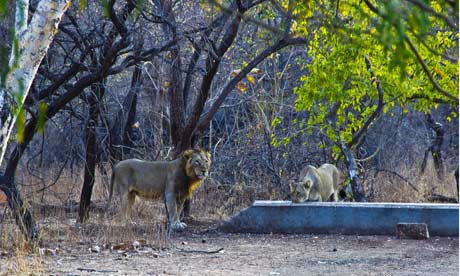
Male and female Asiatic lions drink water in Gir Forest National Park, the threatened species' current habitat. Photograph: Nisarg Lakhmani/Corbis
Ambitious plan to translocate lions from Gujarat to Madhya Pradesh finally gets green light with Supreme Court ruling

Wildlife is under threat in most of India, but there's one state that's clinging to its fauna, if rather too tightly. The state of Gujarat – whose Gir forest shelters the world's only Asiatic lion population – has lost a bitter battle over an ambitious translocation project.

For over 18 years, conservationists have been attempting to move a pride of Gir lions to the Kuno sanctuary in the state of Madhya Pradesh. But the Gujarat government stubbornly refused to let the lions go. Meanwhile, an impatient Madhya Pradesh government bizarrely suggested introducing African cheetahs, whose Asiatic cousin once roamed the area.

Finally, on 15 April, after eight years of litigation, the Supreme Court of India cleared the translocation of the lions, though it said an emphatic no to the cheetahs. Now the reluctant Gujarat government is considering filing a review petition, even as angry locals protest the translocation, some even threatening to kill themselves.

The Gujarat government, and Chief Minister Narendra Modi, have been arguing for years that the Gir lions are the "pride of the state". In court, the lions were described as "family members who could not be parted with." The native Maldhari tribals have lived alongside the lions for years, on the whole peacefully. Even the Supreme Court acknowledged the state's role in saving the lion from an extinction that seemed almost certain only a few decades ago. The latest census put the lion population at 411, up from 359 in 2005.

But most wildlife experts agree that while the state has done well, the lions have outgrown the Gir forest, and a single epidemic or calamity could wipe out the entire population. In 1994, an epidemic of canine distemper killed an estimated 1000 lions in the Serengeti National Park in Tanzania.

"The Gir conservation project has staved off extinction and helped increase population. The translocation is about strengthening conservation prospects and managing success. At the moment, all our eggs are in one basket and that is a huge risk," says Dr Ravi Chellam, well known conservationist and former director of the Wildlife Conservation Society of India. Chellam was one of the experts who recommended the translocation, which he likens to buying life insurance.

In its judgement, not surprisingly, the Supreme Court rejected the Gujarat government's emotional appeal. "The cardinal issue is not whether the Asian lion is a family member, but the preservation of an endangered species," ruled the court, while directing that the lions be moved within six months.

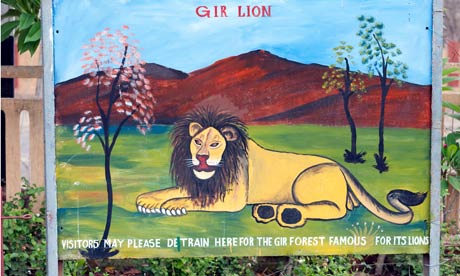
Sign at Sasan Gir Train Station inviting passengers to visit the Gir National Park and Sanctuary in Western Gujarat, India. Photograph: Alamy
Meanwhile, now that the cheetahs have been nixed, the Gujarat government reportedly plans to argue that Kuno is already home to stray tigers from the nearby tiger sanctuary of Ranthambhore. Will two big cats in the same area cause trouble? Most experts say the tiger population in Kuno is too small to make a difference. "Tigers and lions have had overlapping distribution historically. It's still not a good enough reason to deny translocation," says Chellam.

An earlier translocation of lions to the state of Uttar Pradesh in the fifties failed. With insufficient prey and only a small area to roam, the lions hunted nearby village cattle, and were hunted in their turn by angry villagers. This time around, conservationists say things will be different. "Kuno was chosen because of its size-3000 sq km-and diverse prey base. Lions need lots of space, plenty of prey, and protection from people," says Chellam. Wildlife studies have shown that the prey count in Kuno is actually higher than that of Gir. 24 villages were relocated in Kuno, at considerable expense, to make way for the lions, though many villagers complain that they have still not received compensation.

Despite the years of preparation, the hard work has only just begun. Indeed, Kuno is a test case for conservation through translocation. Kuno has a strong gun culture, and the Supreme Court has agreed that forest staff will need to be trained and deployed to prevent poaching. Locals will need to be educated, involved and given a stake in conservation, just as the Maldharis had. The project will need male lions to be moved from Gir to Kuno every three to five years for the next 30 years.

All this means that Gujarat will very soon have to stop sulking and start cooperating. After nearly 20 years of bickering and debate, it's time to put everything else aside and act to save the Asiatic lion.

Source: http://www.guardian.co.uk/environment/terra-india/2013/may/07/india-acts-asiatic-lion-moving

Who started the fire?

M R Manjunath, May 7, 2013, DHNS

Come summer, and State’s reserves face the problem of forest fires. Most of these fires are manmade, and are triggered either by vested interests or by accident. The reasons are many, and so are the methods. 


Dandeli, Nagarhole, Bandipur, Biligirirangana Betta and Kudremukh are the State’s most well-known sanctuaries, which are also tiger reserves. These forest regions are known for their rich biodiversity, from many varieties of trees including sandalwood and honne to a host of medicinal plants. Apart from tigers, the wildlife in these forests include elephants, sambars, deer, bears, langurs, Malabar squirrels, etc.

Come summer, there’s invariably the problem of forest fires. While natural forest fires are part of nature’s cycle, there are other forest fires that are sometimes triggered by man.

Forest fires that occur at a time when the region is already facing drought spells double-trouble for wildlife. The Bandipur region is facing one of its worst droughts ever this year, with all the water bodies having gone dry.

Bamboo, which is present in the forest regions of the State, blooms once in 40 years. Last year and the year before that, bamboo in the State had bloomed. Once the bamboo blooms, it dies. This year, because of the failure of rain, the forest regions in the State are full of dry bamboo. There are elements that misuse such a scenario to trigger a fire. According to forest authorities, the months from February to May call for extra vigil. The reasons for manmade fires are many.

Most forest reserves adjoin agricultural land. Sometimes, farmers trigger fires because they believe that grass growth will improve later, and will provide adequate grazing space for cattle. Then, there is the fear of monkey fever that raises it head during summer. People believe setting fire in the forest could solve that problem. Also, there is the problem of poaching. Poachers and small-time hunters often set fire to leaves because they need to enter the forest stealthily. They try and prevent the rustling of dry leaves when they step on them in the forest, by burning leaves. Tourists inadvertently trigger a forest fire when they throw cigarette stubs. Also, locals looking for honey and non-timber forest produce (NTFP) could set fire in the forest. Then, there are those seeking to avenge punishment meted out to them by the Forest Department, for having chopped trees for firewood. The reasons are many, and the methods are many as well. Forest watchers strive hard to bring the fire under control. The incident of a woman wage worker slipping and falling into the fire when she was trying to douse a fire in the Dandeli forest may be recalled here. The woman succumbed to burns.

It was not too long ago when an incident of some elements triggering a fire in Kulagi range of Dandeli occurred. The Forest Department, on its part, says it is trying its best to create awareness about forest fires and what they do to the ecosystem. Also, to combat drought conditions, the Department has also built percolation pits in the Bandipur region to supply water to wildlife.

Source: http://www.deccanherald.com/content/330710/who-started-fire.html

Trees, wildlife charred in northern Panna forest fire

TNN May 4, 2013
BHOPAL: A fire that broke out in a forest in northern region of Panna district, about 15km from the tiger reserve, on Thursday is threatening the forest cover and wildlife. Plantations in around 35 hectares of forest near Saharia area have reportedly been gutted in the fire that is spreading towards Amanganj area, said forest officials on Friday.

Making matters worse, the fire alert and messaging system (FAMS) developed by the IT wing of the forest department didn't function, sources said. FAMS uses processed remote sensing data of active fire locations and sends instant alerts to concerned field staff through the SMS and e-mail.

More than 80 forest employees and officials have been pressed into service in the area to control the fire, said SK Gupta, DFO North.

A probe has been ordered by the state forest ministry as there are allegations that the it was the handiwork of miscreants to cover up illegal felling of trees over the last few months.

NGOs blame forest officials for the fire terming it as a planned 'incident' to hush up illegal felling and show expenditures of budget allotted for fire protection. "I have moved a PIL seeking investigation on rampant illegal felling of teak woods from the northern range of Panna recently. The fire broke out in the same area. It's intentionally done to destroy the evidences," alleges Shrikant Dixit, who runs an NGO in Panna.

Source: http://timesofindia.indiatimes.com/home/environment/flora-fauna/Trees-wildlife-charred-in-northern-Panna-forest-fire/articleshow/19876054.cms

Monday, 6 May 2013

Contour canal for Parambikulam project turns death trap for wildlife

P. OPPILI, The Hindu

Canal runs to a distance of nearly 50 km: naturalists

  • The project is maintained by the State Public Works Department
An open contour canal constructed during the 1960s for the Parambikulam Aliyar Project in Coimbatore district has become a death trap for wildlife in the Anamalai Tiger Reserve (ATR), Pollachi.

Naturalists and environmentalists say the canal runs to a distance of nearly 50 km, of which a 45-km stretch passes through the ATR.

During seasonal migration and dry periods, elephants, tigers, leopards, sloth bears, wild dogs, Indian Gaur, sambhar deer and spotted deer come to the canal for drinking water. If the animals fall into the canal, it would be difficult to rescue them.

The Project is maintained by the State Public Works Department, which began refurbishing the canal as there were many leaks in it. The work began nearly a year ago.

A. Rangarajan, Secretary, Tamil Nadu Green Movement, said his organisation had sent a letter to the Central Empowered Committee (CEC) demanding a joint inspection of the place with representatives from the PWD, Forest Department and the National Board for Wildlife. The CEC had also sent a letter to the Chief Secretary to arrange for a site inspection.

However, nothing has been done in this regard, Mr. Rangarajan charged. He said the canal, apart from fragmenting the forest, leads to death and maiming of wildlife, which will be more than a dozen annually.

The Forest Department had divided the 49-km canal into eight stretches and conducted a survey.

During the survey, officials recorded the presence of at least half a dozen species of wildlife along the stretch.

Making provisions for the wildlife to cross over from one side to the other is the recommendation for the first stretch which begins from the Power House till the entrance of the tunnel 1; the second stretch is the entrance of the tunnel 1 where the recommendation was to erect railings.

The other recommendations included installing scalable slopes and railings to prevent wildlife from falling into the canal and facility for wildlife to access water along the canal.

When contacted, wildlife authorities said they have requested the PWD to provide platforms to facilitate animals to drink water safely from the canal.

Similarly, they have given a few designs to the PWD authorities, which would help the wildlife cross the canal without any problem.

“Wildlife concerns are well taken care of by the department,” a senior official added.

Source: http://www.thehindu.com/todays-paper/tp-national/contour-canal-for-parambikulam-project-turns-death-trap-for-wildlife/article4685389.ece

Villagers lynch wild bear that killed 8 persons

  • The wild bear started attacking villagers from Saturday
  • It may have been lured out of the forest by the smell of cashew apples and mahua flowers: Forest officials
A wild bear that killed eight persons and injured five persons in the past 24 hours was lynched by villagers in the Kotpad area of Koraput district on Sunday.

The injured were first admitted to the Kotpad Community Health Centre. Later they were shifted to the Koraput district hospital.

According to police sources, the deceased included two women.

Forest officials said a team from the Nandankanan Zoological Park in Bhubaneswar was called in to capture the errant bear by using tranquilisers. Before the team could reach Koraput, the bear faced the wrath of angry villagers.

Villagers upset

The villagers had been upset with the killings by the bear. They had even staged a dharna in front of the forest ranger’s office in Kotpad. They blocked roads at several places in Kotpad.

The villagers tracked down the bear near the Girla village before the forest officials could capture it alive. Eyewitnesses said the animal was first hit by a jeep. Then it was beaten to death by the mob. They then carried the carcass in a procession in Kotpad.. Later, the forest officials seized the carcass.

Laxmikant Mishra, Divisional Forest Officer, and sub-collector Birendra Karkara rushed to the area and promised compensation to the families of victims. They also assured proper treatment of the injured.

Forest officials said the bear might have strayed out of the jungle lured by the smell of cashew apples and mahua flower. Consumption of mahua might have intoxicated the bear following which it could have turned violent.

On Saturday, the bear attacked a group of women returning after collecting firewood from the jungle near Amarmunda village. The animal was hiding under a culvert. One woman was killed on the spot. When people gathered in the area, it bear ran away. Later, it attacked and killed two others near Amarmunda and Totiaguda.

A couple sleeping outside their house were attacked by the animal. The husband died on the spot while his wife died in the hospital. Two other persons of the same village were attacked the same night. The body of another person killed by the bear at Girla was found on Sunday morning.

Source: http://www.thehindu.com/todays-paper/tp-national/villagers-lynch-wild-bear-that-killed-8-persons/article4687577.ece

Voter trampled by elephant

A person, on his way to cast his vote, was trampled to death by an elephant at Phalguni village in Mudigere taluk on Sunday morning.

The deceased Nasir Khan (60), an agriculture labourer, had left his residence after telling his wife that he was going out to vote. He is survived by his wife. The couple had no children.

Deputy Conservator of Forests Raviraj Narayan visited the spot after receiving the information.

He told The Hindu that the elephant had trampled him to death and threw a wooden log on his body.

“His wife told us that he went out around 6.30 a.m. to cast his vote. As he did not return till 10 a.m., people went to search for him. Later they found him dead,” he said.

Source: http://www.thehindu.com/todays-paper/tp-national/tp-karnataka/voter-trampled-by-elephant/article4687935.ece

Railway engineers suggest steps to minimise elephant deaths

With elephants continuing to perish after being hit by trains, railway engineers have suggested multi-pronged strategy to minimise the casualties.

At a day-long fifth annual general meeting and safety seminar of the East Coast Railway Engineers’ Association (ECREA) here on Sunday, its members expressed concern over elephant deaths on railway tracks.

Night vision cameras can be installed on locomotives to detect the movement of elephants or other animals within the range of one km to minimise the deaths. The instruments have night and day vision capability that allows them to operate in very poor lighting conditions,” said Gopal Chandra Nayak, secretary (headquarter) of ECoREA. Mr. Nayak said it was essential to obtain detail information on the movement of elephants and seasonal dispersal patterns in order to protect and manage elephant population effectively.

“Introduction of ‘go slow zones’ can be thought of. In many cases, including some the accidents this year, accidents have happened because the trains are in high speed. Go slow zones in accident-prone areas can be introduced with warning signs to alert the drivers,” he suggested adding that there were limitations in the measures as it would affect running of trains.

Source: http://www.thehindu.com/todays-paper/tp-national/tp-otherstates/railway-engineers-suggest-steps-to-minimise-elephant-deaths/article4688132.ece

Love-lorn tiger enters zoo

AFP

May have travelled over 100 km in quest of mate

A lonely male tiger that left the jungle and entered a zoo in Nandankanan Zoological Park in Odisha in quest of a mate has been trapped, an official of the state-run park said.

"It seems to have strayed into the zoo attracted by a tigress," Sudarshan Panda, director of the Nandankanan Zoological Park near Bhubaneswar, capital of the eastern state of Orissa.

Panda said foresters kept a lookout for the animal, which had travelled from a protected state forest some 100 kilometres from the zoo and roamed around the facility last weekend. The tiger was captured and is now in the tiger safari area, which has been temporarily closed to visitors due to the presence of the wild cat.

The Nandankanan zoological park has a large number of white tigers as well.

India is home to half of the world's rapidly shrinking wild tiger population and has been struggling to halt the big cat's decline in the face of poachers, international smuggling networks and loss of habitat.

The country has seen its tiger population plummet from an estimated 40,000 animals in 1947, when it gained independence, to just 1,706 in 2011.

Source: http://www.thehindu.com/todays-paper/tp-in-school/lovelorn-tiger-enters-zoo/article4687447.ece