Thursday, 14 February 2013

Dry canals drive leopards to villages

Residents of Hulikere and nearby areas report 20 sightings in a month

  •  ‘Pugmarks recorded near water tanks in villages’
  • Cages at Hulikere, Hulikere Koppalu to trap the animals


The plummeting water-level at Krishnaraja Sagar (KRS) has prompted the Irrigation Department to stop releasing water into the reservoir-dependent canals. With the dried canals has come another consequence: leopards have been entering villages in search of drinking water.

The Forest Department has observed the big cats entering Hulikere, Hulikere Koppalu and surrounding villages in the taluk, looking for water and food — sheep. Area residents have spotted leopards on around 20 occasions in the past month.

“We have recorded pugmarks near water tanks in villages,” Mohammed Jaffer, Range Forest Officer (Mandya), told The Hindu .

Following the repeated sightings, the Forest Department has placed two cages at Hulikere and Hulikere Koppalu to trap the animals.

Attacks

At the two villages, incidents of leopards entering cattle-sheds and killing sheep, goats, chicken and dogs have been reported. Residents are confining themselves to their houses after dusk.

Raghu, a farmer at Hulikere, claimed five leopards were roaming in the vicinity of Hulikere, Hulikere Koppalu, Mallenahalli and Thibbanahalli. He himself had seen an adult and two cubs near his fields, he said.

According to him, peacocks and foxes, which were common in the region until a few weeks ago, are barely to be seen now because of the leopards. Some dogs too have gone missing from the village, he said.

‘Three leopards’

Mr. Jaffer, however, believes there are three leopards in the area.

Recently, forest officials visited Hulikere and interacted with the residents. Mr. Jaffer and his team also studied the movements of leopards based on the pugmarks.

“Three leopards, including two cubs, might have been wandering in the region,” he said.

The department has also deployed additional staff at the villages to monitor the movements of the animals. They would be shifted to forest once they were trapped, he added.

Source:

Wednesday, 13 February 2013

Predator population up in tiger reserve

P. SUDHAKAR

Time to strengthen its prey base

Herbivore: A small herd of Nilgiri thar found at
Uppur Kothayar in Western Ghats in Tirunelveli district.
The recent wildlife census conducted at Kalakkad – Mundanthurai Tiger Reserve (KMTR) shows a significant increase in the predator population and signals the need to strengthen its prey base or herbivore population.

When the survey team crossed Rettaikaradu area in Thirukkurunkudi range, the members saw a panther, a ‘shy animal’, taking rest under a shade and another team, which was trekking near Maanjolai above Manimuthar dam, saw a panther standing on a rock at a distance.

The enumeration team that was moving around Kadayam range was the most fortunate as it happened to see a tiger.

“This time the volunteers involved in the census were able to see a number of panthers, which shows that the predator’s population has increased significantly. We firmly believe that the tiger population should also have gone up as we’ve got interesting and highly encouraging findings in certain areas of KMTR,” said K. Sekar, Deputy Director, Kalakkad – Mundanthurai Tiger Reserve’s Kalakkad Division.

Though KMTR has a sizable population of Indian Gaur, sambar and spotted deer, the most preferred prey for tiger and panther, ecologists here feel that the existing prey base should be strengthened further.

When the panther population increased in the Tirupathi hills, forest officials said that steps were taken for strengthening the herbivore base, mainly the deer population.

They argued that similar steps could be taken here too by shifting hundreds of spotted deer, now struggling to find adequate food and shelter at Gangaikondan, to Mundanthurai area of KMTR.

“Since these animals (at Gangaikondan) often face a serious threat from speeding vehicles and stray dogs, and rarely from poachers, they can be shifted to the KMTR where they can easily find adequate food and shelter,” said a zoologist here.

Forest officials say that the spotted deer of Gangaikondan could be transported to KMTR in camouflaged vehicles after tranquilizing them to strengthen the predators’ prey base.

“We have an adequate number of officials, who are well-trained in tranquilizing and transporting the sedated animals in disguised vehicles to Western Ghats during the night. If the government approves this proposal, we can expect an improved ecosystem in KMTR in future,” said a senior forest official.

Source: http://www.thehindu.com/todays-paper/tp-national/tp-tamilnadu/predator-population-up-in-tiger-reserve/article4413646.ece

Blood on the Tracks

Jay Mazoomdaaar | 9 February 2013
Hundreds of kilometres of railway tracks run through our wilderness. Every time elephants are run over, we question if the killer train broke the speed embargo of 40-50 kmph inside forests. At the same time, we also cheer Indian Railways as it aspires to run high-speed trains by 2020 that will clock 250-350 kmph.

Last week, the Parliamentary Standing Committee on Railways met to discuss how to stop elephant deaths on railway tracks. Between 30 December and 13 January, 11 elephants were killed on railway tracks in three corners of India. Each site has long been designated an elephant zone, where locomotive drivers are supposed to follow real-time inputs from forest staff on elephant movements, watch out and go slow.

The stretch close to Berhampur in Odisha, where the Coromandel Express ran over six jumbos on 30 December, between two warning signs of elephant movement put up by the Railways itself, has seen many more wild animals killed in the past, including an elephant last May. The tracks between north Bengal’s Alipurduar and Siliguri, which claimed three jumbos inside Buxa tiger reserve this month, was responsible for three dozen elephant deaths in the last decade. The third accident took place between Haridwar and Dehradun, where a high-profile protocol to avoid elephant deaths on tracks tripped after 12 years.

What matched these deaths in their unpredictability was the official blame game that followed. In Odisha, the Railways claimed that the input on elephant movement had reached it too late. In Bengal, it said the locomotive driver was well within rights to go at 100 kmph in the dark because it was still half an hour to 7 pm when speed restrictions come into force. At Haridwar, where a speeding Shatabdi hit the herd under a clear morning sky, it was blamed on the sudden emergence of the animals on the track. The Odisha forest authorities complained that the trains were not following speed restrictions along vulnerable elephant zones across four districts. In Bengal, the department increased the length of the go-slow zone along the 163 km stretch between Alipurduar and Siliguri from 17.4 km to 97 km. It also woke up to the fact that the 7 pm-5 am low-speed window did not cover the extended dark hours during winter and imposed a sunset-sunrise schedule.

In March 2010, the environment ministry had issued an advisory to the Railways to avoid elephant deaths. Six months on, when seven elephants were run over in north Bengal, then Environment minister Jairam Ramesh talked tough, waving that advisory. Last week, his successor Jayanthi Natarajan circulated the same advisory yet again. She also spoke of updating “the list of well-known vulnerable patches for wildlife”, posting forest staff at Railway control rooms in sensitive areas and regular meetings between the ministries.

Then, to throw in some novelty, the minister announced “a pilot scheme to electronically tag all elephants particularly in high-traffic areas” to ensure railway officials were warned “well in time”. Satellite collars can send real-time data on herd locations at quick intervals. But is it feasible or even desirable to collar hundreds of elephants? Forget the high density landscapes of Odisha and Uttarakhand, Buxa in north Bengal alone has more than 200 elephants. Other vulnerable forests in that region—Jaldapara, Gorumara, Chapramari and Mahananda—have many more.

+++
Though elephant deaths are the most visible, thousands of wild animals die on railway tracks and highways that cut through forested areas every year. These accidents also risk passenger safety. The night six jumbos were mowed down near Berhampur last month, one person died on board from the impact of the collision. So far, the Railways have been lucky to avoid major passenger casualties. But collisions with elephants almost invariably damage and derail locomotives, lead to temporary suspensions of service, and cost the exchequer in crores every year. Yet, none of our remedies, such as tagging all animals or imposing blanket speed limits or banning night traffic, is practical.

Rail and road traffic must move fast to be efficient. Speed restrictions are feasible only when imposed along a short stretch, such as the 11 km killer track near Berhampore in Odisha or the 8 km stretch that cuts through Jharkhand’s Palamu or the 4 km death trap in the Palghat Gap that connects Kerala’s Palakkad and Tamil Nadu’s Coimbatore on both sides of the Western Ghats. But what is the point of restricting speed along nearly 100 km between Alipurduar and Siliguri when there is a less vulnerable alignment available through Fala- kata in north Bengal?

Of the 88 identified elephant corridors in India, 40 have national highways running through them, 21 have railway tracks and 18 have both. Not only these corridors, roads and railways cut through hundreds of kilometres of elephant and other wildlife habitat. It makes no economic sense to impose speed restrictions on such lengths of the network. Worse, accidents can never be ruled out even at low speeds due to a number of factors, including human error.

“If there is traffic, some loss will always happen. But limiting speed over long distances is not a realistic long-term solution. If we are serious about minimising damage, we have to take radical measures acceptable to all stakeholders and not only conservationists,” says Ajay Desai, co-chairman of the Elephant Task Force (ETF), set up by the MoEF in 2010. Vivek Menon, executive director of Wildlife Trust of India (WTI) and a member of the ETF, points out that speed restrictions are anyway not an option on steep gradients, such as Assam’s Karbi Anglong, where trains must run fast to climb the slope. The best way to ensure both efficiency and safety, agree Desai and Menon, is to realign where possible road/ rail corridors that cut through critical forests.

But some alignments must still cut through forests. For example, if Dehra- dun has to be connected, the tracks must pass through Rajaji national park. But even there, speed is not the only killing factor. A team of WTI researchers studied accidents in Rajaji and found that most elephants were run over by trains at spots where either the locomotive was coming round a bend or the track was flanked by sharp slopes.

Interventions based on this knowledge and reduced speed ensured that no elephants were killed on this track for 12 years till the system tripped last week. Insiders blame it on the complacency of both the ground patrol team and the drivers. More than a decade ago, the Railways had sought to fence off the most vulnerable stretch of this track and experts cleared the proposal since it did not significantly hamper herd movement. The fence, however, is still not in place. Desai says monitoring herds and alerting drivers of their presence cannot be a fool-proof method in difficult terrain. Menon prescribes site-specific solutions that are practical and scientific. But when it comes to the Railways or highway authorities, the stock solution is to provide low-cost overpasses or underpasses, which are no more spacious than drainage or service ducts.

A few years ago, the Supreme Court sought the view of the Wildlife Institute of India (WII) on the viability of building two elephant overpasses on a national highway that cut through Rajaji national park. Asked if elephants would use those overpasses, the WII chief said: “Ask the elephants!”

The SC rejected the overpass plan. Instead, a 0.9 km elevated stretch of highway between Motichur and Doiwala is being built at a cost of Rs 100 crore. There is a similar demand in north Bengal to build elevated tracks over the most vulnerable stretches. But the authorities insist on cheaper solutions.

All over Europe, Canada and the US, hundreds of artificial passages help reduce animal road kill. But most of these are used by amphibians, invertebrates, badgers, ungulates and other small mammals. Among the largest animals to benefit from such artificial access are mountain goat (Montana), mule deer, elk, moose (Nugget Canyon), the bighorn sheep (Colorado) and the panther (Florida). But there is no record yet of elephants using an overpass.

Sensitive to vibrations caused by the traffic below, elephants are unlikely to use an overpass even if it is built by joining two hillocks in a way that the natural alignment appears intact. They also avoid narrow tunnel-like underpasses. Funnelling the animals towards the underpass is also critical because herds stick to their traditional routes. The first instance of elephants taking an underpass was recorded in South Africa’s Kwazulu Natal province. Then, Kenya built a six-metre long underpass, linking Mount Kenya National Park and Nagre Ndare Forest Reserve, which is being used by herds since last year. At home, solitary bulls occasionally used the Dogudda aqueduct to cross the Chilla-Rishikesh highway but matriarchal herds stayed away. Then, towards the end of 2010, we had the first evidence in India that underpasses, when built properly, do allow regular herd movement.

About 35 km of NH 152 that connects Assam’s Pathsala to Bhutan’s Nganglam cuts through the buffer zone of Manas national park. Anwaruddin Choudhury, then deputy commissioner of Buxa district, insisted on realigning the original road that ran through the core of the national park and constructing two underpasses.

“For once, both the state and central authorities were receptive to the idea. Knowing that budgetary constraints will inevitably scale things down, I asked for 100 metre long and 50 feet high underpasses because elephants rarely squeeze through narrow gaps,” recalls Choud- hury. When the highway was ready in 2010, it offered two 30 feet high and 100 feet wide passageways, which elephant herds started using within months.

The other solution, as has been recommended for the highway cutting through the Kaziranga landscape, is to take the road underground. Technologies such as elephant sensors that trigger automatic braking have the potential of making railway tracks safer for animals. In many areas, says Desai, it is possible to simply funnel elephants with fencing to designated level-crossing zones where they, particularly calves, will not struggle to climb up or down the tracks. It is important, though, to use barriers across the tracks at such crossings so that jumbos do not get trapped by entering segments flanked by fences.

With the Railways planning to expand in the red corridor, new tracks will be laid across vast tracts of elephant forest in central India. The highway authorities have been pushing for clearances to expand roads through some of India’s best wilderness. “We have to prioritise because we cannot overnight realign all forest routes across India. But we must consider the speed and safety issues while planning these new projects,” warns Menon.

Be it realignments, flyovers, tunnels or spacious animal passageways, the infrastructure solutions will require additional investment. But India cannot shy away if it wants to protect the interests of both its economy and its wildlife. Otherwise, we can keep ignoring the loss of thousands of train hours and console ourselves that angry villagers in Buxa protested on the track for three hours, that the meat of dead elephants was sent to feed vultures at a local breeding centre, and that nearly two dozen people joined a candlelight vigil at Alipurduar.

Source: http://www.openthemagazine.com/article/nation/blood-on-the-tracks

Wild elephant electrocuted

A 20-year-old tusker was found dead near Madakkadu on the Isha – Narasipuram Road in Booluvampatti range near Coimbatore in the small hours of Monday (February 12, 2013).

Clinical examination indicated that the death could have been caused by electric shock from a live wire used in an electric fence in a farm. The farm owner had used direct power supply to the fence instead of alternative supply.

On instructions from Conservator of Forests, Coimbatore Circle, V.T. Kandasamy and District Forest Officer V. Thirunavukkarasu, a team led by Forest Range Officer M.S. Parthiban conducted investigations. Forest Veterinarian N.S. Manoharan conducted a post-mortem and the carcass of the pachyderm was consigned to flames.

Forest Officials registered a case against the owner Balasubramanian (70) and his son Babu (40) for using direct power supply causing the death of wild elephant invoking the provisions of Section 9/1 of Wildlife Protection Act of 1972. An offence under this section is likely to attract seven years rigorous imprisonment.

Source: http://www.thehindu.com/todays-paper/tp-national/tp-tamilnadu/wild-elephant-electrocuted/article4406036.ece

Elephant found dead

A 20-year-old male elephant was found gored to death in Sundapatti Reserve forests near Nellithurai in Mettupalayam area on Sunday (February 11, 2013).

Forest veterinarian N.S. Manoharan conducted the post-mortem examination.

Source: http://www.thehindu.com/todays-paper/tp-national/tp-tamilnadu/elephant-found-dead/article4402051.ece

1,000 snakes released into Palar

Chennai: Panic gripped the villagers of Ayambakkam, near mad­ura­nthakam in Kanche­epuram district on Satu­rday as the morning walkers and farmers were greeted by hundreds of snakes that were released by some unknown people in the area the previous night.

The villagers claimed that there were more than 100 snakes released into Palar river basin and suspect that the miscreant had come in a Pondicherry-registered bolero car. “What we saw was a large number of snakes near the river bank, an unusual sight and a twenty year old was bitten”, said T.S. Bhaskar, Ayambakkam villaghe panchayat president, who rus­hed to the place after the villagers ran helter skelter. The scared villagers on seeing the reptiles started killing them and at least half a dozen reptiles were found dead. Cobra, rat snake and kraits were there and we alerted the forest department, added the local body president.

When contacted Tiru­porur forest ranger Siva­ram confirmed the incident. Based on the information forest guards were deployed to the scene and Irulas were also brought to catch the snakes. More than twenty snakes were caught.  Preliminary investigations have confirmed that the snakes were released on purpose and a few villagers noticed a bolero car with Pondic­herry registration station­ed near the river bank the previous night. The rescued reptiles have been sent to for herpetology at the Madras Crocodile bank at ECR. The issue has been taken to the higher officials who will co ordinate with the Pondicherry forest depa­rt­ment, he said.

Source: http://www.deccanchronicle.com/130210/news-current-affairs/article/1000-snakes-released-palar

Tuesday, 12 February 2013

Forest officials concerned over bridge

S. HARPAL SINGH

Say the new bridge over Godavari river aiding teak smugglers in Adilabad district

A new high-level bridge across the Godavari river near Kalamadugu in Jannaram mandal has become a cause of alarm for forest officials of the Kawal Tiger Reserve (KTR). The bridge reduces considerably the distance to a few towns like Jagityal in neighbouring Karimnagar district which is likely to become an attractive proposition for timber smugglers operating in Adilabad district.

“The bridge can actually bring our efforts at controlling teak smuggling to a nought. We are in the process of establishing a check-post at the new entry point to Karimnagar district”, says Jannaram Divisional Forest Officer (DFO) G. Rama Krishna Rao revealing the apprehension of his department.

While illegal felling of teak is under check within the confines of the KTR, smugglers are having a field day elsewhere in the district.

A whopping Rs. 13 to Rs. 14 crore worth teak seized in continuing operations, was auctioned at the Ichoda and Khanapur timber depots since April last year. “About 3,000 cubic metres of illegally felled teak was seized from the forests of Ichoda, Nirmal and Khanapur.

The situation is more than alarming considering the fact that this seizure is taken to be just 10 per cent of all teak felled in smuggling activity in this area”, reveals a top forest official as he tries to throw light on intensity of smuggling activity.

Teak transport

Teak from the interior parts of Ichoda and Khanapur is transported to Nizamabad and Karimnagar through several routes mainly over different bridges on Godavari. The Forest Department already has check-posts at Soan in Nirmal, Badankurti in Khanapur and Gudem in Dandepalli mandal.

“Smugglers even from distant Ichoda can cross over into Karimnagar through the Kalamadugu bridge. They can transport teak to this place through interior parts of Ichoda mandal via Pembi”, the forest official points out the inherent attraction for timber smugglers.

Source: http://www.thehindu.com/todays-paper/tp-national/tp-andhrapradesh/forest-officials-concerned-over-bridge/article4405749.ece

Sunday, 10 February 2013

Monkey fever detected in black faced langur in Mudumalai

S M Arun
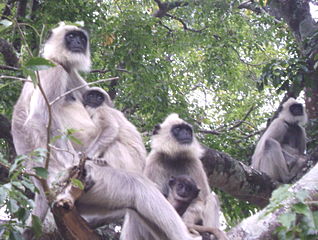
Common Langur or Tufted gray langur
COIMBATORE: For the first time since the discovery of Kyasanur Forest Disease (KFD) or Monkey fever in March 1957, the disease which is endemic in the state of Karnataka has entered Tamil Nadu. A black faced langur found dead in Mudumalai in the Nilgiris could have been infected with the disease, say forest officials. The body of black-faced langur was found a week ago in Mudumalai and the autopsy report revealed that the death was due to the KFD virus. Since it is the first time the presence of the disease is confirmed in Tamil Nadu, health officials in both Nilgiris and Coimbatore districts were put on high alert.

The disease is transmitted by bite of KFD infected ticks and has a mortality rate of 4 % to 15 % in human being; say Indian Council of Medical Research (ICMR) studies. Hunters, forest workers, farmers, campers and trekkers are those who are highly susceptible to the disease as infected ticks could transmit it to humans when they enter forests. They might carry the ticks with them to their homes and it could become epidemic. Coimbatore deputy director of health services Dr R Damodharan said after KFD was reported in Mudumalai, forest department staff in the Nilgiris have been vaccinated against the disease.

"Health officials have been put on alert. So far no KFD incidents have been reported in Coimbatore. We have also intensified the monitoring and surveillance," he said. He said 11 human KFD cases were reported in Gundlupet area recently and one of them succumbed to the disease. The symptoms include fever with bleeding disorders and a reduction in platelet counts, RBC and WBC. "Hospital on wheels and Medical Outreach (MO) Services in tribal areas have been put on alert in Coimbatore-Nilgiri border areas," he added.

Though vaccinations are available against KFD, there is no specific treatment. But, timely supportive therapy reduces mortality in humans. Besides tick bites, humans can get infected by the disease following contact with an infected animal. The disease was named after the forest area where it was discovered. Diagnosis of KFD is normally through enzyme-linked immunosorbent serologic assay (ELISA), the same test which is used to diagnose dengue.

With more and more people taking to trekking and camping in forests and also visiting tourist spots like Mudumalai in the Nilgiris, the risk factor is higher and the transportation of infected ticks from forests to cities will be disastrous especially at this juncture when the KFD infection has been confirmed in Mudumalai.

Source: http://timesofindia.indiatimes.com/city/coimbatore/Monkey-fever-detected-in-black-faced-langur-in-Mudumalai/articleshow/18438275.cms

Tortoise smuggling bid thwarted, 2 held

A fresh water tortoise that was rescued by forest officials, in the city
on Saturday | Martin Louis
Chennai: Two persons, suspected to be couriers, were caught at the International Airport here when they attempted to smuggle 27 fresh water tortoises to Bangkok on Friday night. The two couriers, who had been transporting textile clothing for more than 10 years, claimed they received the baggage with the tortoises at Central Railway Station but were not aware of what was inside it.

Forest officials said that the passengers, H Shamsudeen (67), a native of Kamuthi in Ramanathapuram district currently living in Washermenpet in Chennai, and M Mohamad Yoonus (47), of Ilayangudi in Sivagangai district and presently living in Seven Wells here, were caught before they could board a flight to Bangkok. Customs officials fell suspicious of the stroller suitcase they were carrying and intercepted them. When the officials checked their baggage, they found 27 fresh water adult tortoises neatly packaged and kept inside.

Customs officials questioned the duo and found that they did not possess any valid document to carry the species, protected under the Schedule IV of Wildlife Protection Act, 1972.

The passengers were detained and were later handed over to the forest department.

Forest officials said the duo was booked under Section 39 (3) (A) (B) and 48 A of the Wildlife Protection Act. “They claimed they received the baggage from an unidentified man at Central Railway Station around 5 pm on Friday before heading for the airport. The maximum punishment for such an offense is seven years imprisonment,” said S Davidraj, forest ranger, Velachery range office.

Mohamed Yoonus, one of the passengers, told Express that he had been operating as a carrier for the past 20 years transporting textile clothing from merchants in North Chennai to Malaysia and Bangkok. “I have been doing this for the past 10 years. Once we get acquainted with a person, we don’t check or inquire what they have in the baggage. We were told we would get `3,000 and were instructed to hand over the box to a man waiting at Bangkok airport wearing a black shirt,” Shamsudeen, the other passenger, told forest officials. But passengers could not give a convincing reply when asked by forest officials why they did not check the content of the baggage when they received it from a stranger.

The rescued tortoises were given carrots and cabbage and the officials said they would be sent to the Arignar Anna Zoological Park in Vandalur. Last time around a similar arrest was made at the Airport in 2010, officials said adding that smuggling of wildlife through Chennai had come down considerably due to intensive checking and strict punishments.

Source: http://newindianexpress.com/cities/chennai/article1457314.ece

A lifeline under siege

N. SHIVA KUMAR

Though they play a vital role in sustaining the eco-system, the country’s natural wetlands are falling prey to rising pollution and urbanisation.

Water lily: Disappearing fast along with vanishing wetlands. Photos: N. Shiva Kumar
The World Wetlands Day (WWD) was observed sporadically across India on February 2 and yet many of us are not aware about the richness and necessity of wetlands in our lives. While wetlands are nature’s water storage and water purification zones, they are also a paradise for wildlife, fishing, angling and bird-watching, water sports, relaxation and rejuvenation. Scientists believe that wetlands are the kidneys of nature. Unfortunately, wetlands today have become mere dumping grounds for garbage, rapidly throttling the water bodies.

Over the centuries, India had a number of sustainable natural wetlands and these were the lifeline of local communities who depended on these water bodies for staple food, livestock grazing, fodder, fuel-wood transport and irrigation. In addition to the natural wetlands were a number of man-made traditional reservoirs constructed virtually in every town and village — supplying water for everyday needs. However, with booming population and burgeoning urbanisation, these self-sustaining water bodies have become increasingly filthy and unfit for human utilisation. Even the beautiful lotus and water lilies, which were part and parcel of wetlands, have disappeared in many regions.

The country’s rivers have turned into giant gutters carrying waste released by thousands of towns and cities. Although considerable money has been spent to cleanse these waterways, the government’s indifference and citizens’ ignorance have resulted in the continuation of debris being dumped into the rivers. It is estimated that three billion litres of sewage flows into the Ganga alone daily with industries also contributing their effluents.

Over the years, wetlands have been neglected and have not gained importance as other areas of nature and wildlife conservation. It is imperative that wetlands occupy the heart of conservation efforts as water management is at the core of sustainable uses of wetlands. Water scarcity today is becoming an urgent problem for mankind that needs effective remediation.

For the WWD this year, the theme set by UNESCO’s Hydrological Programme was ‘Wetlands Take Care of Water’. It reflected the interdependence between water and wetlands. “Making the link between wetlands and water is essential because without water there will be no wetlands — and without wetlands there will be no water! Wetlands such as mangroves, bogs, freshwater swamps are home to a wealth of biodiversity. Wetlands fulfil vital roles in carbon storage, pollution control and protection from natural hazards such as floods and storms. Millions of people around the world relay on wetlands as it provide ecosystem services such as food, fresh water and fuel,” says Mark Smith, director of IUCN’s Global Water Programme.

By the virtue of its geographical location, varied terrain and climatic zones, India supports a rich diversity of inland and coastal wetlands; but they are in distress currently. The Wular Lake in Kashmir or Kolleru Lake in Andhra Pradesh, two of the largest lakes in the country, are depleting as they are losing their vitality to regenerate. The story is similar for other lakes and rivers across the subcontinent.

The National Wetland Atlas, prepared by Space Applications Centre (SAC) of the Indian Space Research Organisation (ISRO), has classified 67,429 wetlands in India occupying 60 million hectares, including paddy cultivation. The majority of these inland wetlands are dependent on major rivers like the Ganga, Brahmaputra, Narmada, Godavari, Krishna and Cauvery. However, with rising water pollution, drought and water battles between various States, conservation of wetlands needs to be taken up on a war footing.

Fortunately, some of the wetlands are receiving their due importance for their contribution to the natural wealth. For instance, the Chilika Lake in Odisha is about to become the first lake from Asia to adopt the “Ecosystem Health Report Card” — an effective means of tracking and reporting the health of a wetland. The Chilika will join the elite club of iconic wetlands like Chesapeake Bay (U.S.A) and the Great Barrier Reef (Australia).

“Increased human population around wetlands adds to ecological degradation due to unsustainable practices like agriculture expansion and over-exploitation. Due to this both wildlife and people suffer, particularly water birds like the cormorants. The condition of the existing wetlands needs to be conserved as our natural assets. With judicious use of numerous useful aquatic bacteria, plants and animals associated with wetlands, harmful impurities can be removed and water can be purified,” says Emeritus Professor C.R. Babuin, in-charge of Centre for Environmental Management of Degraded Ecosystems, University of Delhi.

Source: http://www.thehindu.com/sci-tech/energy-and-environment/a-lifeline-under-siege/article4397277.ece